Showing posts with label Cook County. Show all posts

Monday, January 21, 2019

Walk heads to 11-story Chicago lighthouse

Grosse Point Light
Grosse Point Light aerial map. Click for larger version.
Lighthouse aficionados can explore one of the few light stations in the Chicago metro area at Grosse Point Light in Evanston.

The brief 0.1-mile walk heads to an 11-story tower that guided ships along the Lake Michigan shoreline to Chicago Harbor. It sits north of Chicago, the king of ports on the Great Lakes.

To reach the lighthouse, from Interstate 94 in Evanston, exit onto Old Orchard Road and head east. At Gross Point Road, turn left/northeast then at Central Street go right/east. Turn left/north onto Sheridan Road and take the very next right/east. Park in the lot for the Harley Clarke Mansion. The lighthouse is south of the Clarke Mansion.

The 113-foot tower rises over a 3.5-acre site only a few hundred feet from what is now Lighthouse Beach. It protected ships from dangerous shoals just off the shore in Lake Michigan.

141 steps
After several shipping disasters near the point – particularly the 1860 sinking of the Lady Elgin, which claimed more than 300 lives – a lighthouse was constructed there in 1873. The lamp was lit the following year.

The keeper's quarters, made of Cream City Brick encased in concrete bracketing, follows the Italianate design. It is yellow with red trim and a red roof.

Its conical light tower stands on a concrete foundation. The tower consists of two walls with air space between them. The inner wall is 8 inches thick and rises vertically while the outer wall is 12 inches thick and slightly inclined. At the base, the tower is 22-feet around but narrows to 13 feet 3 inches at its parapet. Inside, 141 steps lead to the top. Glass and iron construction make up the lantern section, and the roof is copper sheeting.

In its heyday, the lighthouse flashed twice every 15 seconds. The light could be seen up to 21 miles away.

Tours and beach
The lighthouse was automated in 1935 and temporarily inactive from 1941-45, as a precaution against possible air raids. Since then it has served as a secondary navigational aid.

One local legend states that in 1674 explorer Father Jacques Marquette landed on Grosse Point. There is no historical evidence, however, that the landing occurred.

Despite Chicago’s rich maritime history and role as the largest Midwest port, Grosse Point is the only real lighthouse museum in the metro area. The grounds can be walked any time of the year with the keeper's quarters and the tower open on summer weekends. Tour sizes are limited to 12, and children under 8 years old are not allowed.

After taking in the lighthouse, you can extend the visit by heading to Lighthouse Beach. A path from the Clarke Mansion parking lot heads east to the sand beach.


Thursday, January 12, 2017

Trail passes wild river, 400-year-old trees

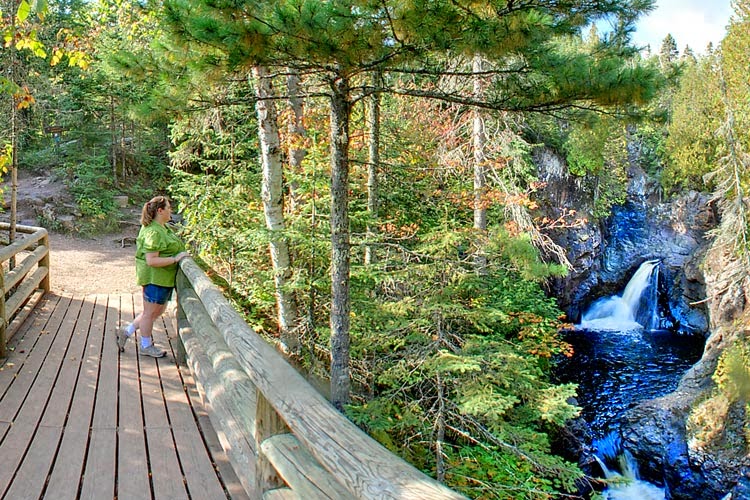
A section of the West Manitou River Trail.
Photo courtesy of Minnesota DNR.
Day hikers can enjoy rustic North Shore landscapes on a scenic loop at Minnesota’s George H. Crosby Manitou State Park.

The 3.3-mile Middle-West Manitou-Misquah-Yellow Birch Loop combines four trails as it winds through the highlands overlooking Lake Superior. Along the loop, day hikers can experience a river rumbling over ancient rock and an old growth forest boasting centuries-old trees.

George H. Crosby Manitou State Park is perfect for hikers and campers who prefer a primitive nature setting. The park has no developed facilities, in accordance with the wishes of its namesake, a famous Minnesota mining executive who was an avid outdoorsman.

To reach the park, from Silver Bay travel north on Minn. Hwy. 61, turning left/northwest onto Minn. Hwy 1. In Finland, go right/northeast onto County Road 7 (aka Cramer Road). Take a right/east into the park, using the lot where the road loops back on itself.

Superior Hiking Trail
The first leg of the loop, the Middle Trail, starts on the lot’s north side. This portion of the trail also is part of the Superior Hiking Trail.

In keeping with the park’s primitive nature, the gently rolling dirt trail is narrow and crosses several small stones and tree roots. A boardwalk runs over a wet, boggy area, then the trail climbs a rocky slope.

After 0.3 miles, a side trail heads to an overlook. The view is worth the few extra steps. Past the overlook, the side trail rejoins the main route; at that junction, go right/north onto the Middle Trail.

Among the interesting sights following the overlook is a birch tree growing atop a boulder with roots clinging to the rock as breaking into the ground. The trail next passes an open log shelter that is a great spot for a break.

At 0.9 miles, the Middle reaches the West Manitou River Trail. Go left/northwest onto the latter.

River views
An overlook is 0.15 miles from the intersection. The rock knoll offers great view of the river valley below. The vista is stunning in autumn, when the changing leaves paint the forest in a rainbow of harvest colors. From there, descend several wooden steps to the Manitou River’s cascades.

After taking in the rapids, turn back, following the trail southwest along the river, which can be seen through several tree breaks. The Manitou River rushes over basalt set down in lava flows some 1.1 billion years ago. The water is the color of frothy root beer due to the dead leaves, grasses and other organic material that drain into the waterway; the hard rocky river bottom causes the water to tumble and aerate. Manitou means “spirit” in Ojibwe.

In 0.6 miles, after passing several spurs to campsites, the Superior Hiking Trail splits to the left/north where it crosses the river. Instead, go right/south onto the Misquah Trail and away from the Manitou.

This section of the loop heads through an old growth forest for a half-mile with a couple of overlooks just off the trail.

Ancient birch
After passing a spur to campground site 7, the trail curves west. In 0.4 miles from the spur, you’ll reach the Yellow Birch and Cedar Ridge trails. Go right/northwest onto the Yellow Birch.

This portion of the loop also runs through an old growth forest. Some of the birch trees here are around 400 years old, starting as saplings when the Pilgrims first arrived in America. Because of the thick forest, the trail here is rugged.

Wildlife frequently can be spotted along this part of the loop. Be forewarned that black bears are among the park’s denizens; should you see a bear, simply make loud noises to scare it off. Being noisy while you hike usually is sufficient to keep bears deep in the woods.

At 0.3 miles, the trail passes a connector to Bensen Lake. Stay on the main route. Then, in another 0.3 miles, you’ll reach the road to your parking lot. Follow it right/north to your vehicle.

Learn about trail guidebooks available in the Hittin’ the Trail series.


Thursday, May 28, 2015

When to hike Minnesota’s North Shore

Waves from Lake Superior crash against Minnesota's rocky North Shore.
The best months to day hike Minnesota’s North Shore are mid-May through September.

Depending on the year, April and October also can be pleasant.
During spring, waterfalls run at their highest levels, the bird migration is in full swing, and bugs are nil. Trails can be muddy, though, as snow typically melts between April and early May.

Unlike the rest of Minnesota, summers on the North Shore usually are not hot, as cool breezes off Lake Superior keep heat and most insects at bay. Rain, however, can occur during the afternoon even when the morning is sunny, so always check the weather forecast before heading out.

For many hikers, autumn marks the best time to hit a North Shore trail. By mid-August, summer’s bugs are gone, trails are mostly dry, and throughout September maples and aspen light the wilderness with color. A sweatshirt often is needed during the day, though, and nights can be chilly.

Mid-October through March usually is too cold and wet for day hiking. Once snow falls, trails typically are used for cross-country skiing, snowmobiling or snowshoeing.

Five great North Shore trails include:
High Falls Trail (Tettegouche State Park)
Ridge Loop Trail (Duluth)
River View Trail (Gooseberry State Park)
Shovel Point Trail (Tettegouche State Park)
Split Rock Light Station Trail (Split Rock Lighthouse State Park)

Read more about day hiking Northeast Minnesota in my Headin’ to the Cabin: Day Hiking Trails of Northeast Minnesota guidebook.


Saturday, February 21, 2015

Hike to skyscraper view of Lake Superior

Carlton Peak rises over Lake Superior, as seen from Britton Peak.
Photo courtesy of  U.S. Forest Service.

Carlton Peak rock
rose to surface
billion years ago


Grand views of Lake Superior and the surrounding countryside await day hikers atop Carlton Peak on the Minnesota North Shore.

A moderately steep segment of the famous Superior Hiking Trail heads to the peak, whose bald rock summit towers 85 stories over Lake Superior. Carlton Peak is in Temperance River State Park, but much of the 7.6-mile (round trip) trail heads through the Superior National Forest.

To reach the trailhead, from Tofte, Minn., take County Hwy. 2 (aka Sawbill Trail) north for two miles. Park in the Britton Trail Trailhead lot on the road’s east/right side. Don’t park in the Carlton Peak overlook, which is more of a wayside.

Head south on the trail, which crosses a mixed hardwood forest. There’s lots of birch and pine, but also a good amount of maple along the way.

Spur trail to overlook
The trail is a gradual uphill climb most of the way. It crosses County Road 2, so watch for traffic, and then make sure you don’t accidentally turn onto the intersecting Lutsen Trail.

Next, the trail crosses Carlton Creek, which flows down the hill into Lake Superior. Boardwalks are in place here and wherever else the trail dips through wet areas.

You’ll soon notice a lot of rocks and boulders along the trail, giving you the same feel as if hiking a mountain out west. Carlton Peak is one of the points on the Sawtooth Mountains range, which stretches along the North Shore.

A spur heading east leads to the Ted Tofte Overlook (look for the sign nailed to a birch tree), which offers unobstructed views. The Carlton Peak summit looms over the overlook.

Heading back to the main trail, continue south/west. Watch for signs that point to the summit. The trail becomes much steeper here with some cliffs, so keep a close eye on any children accompanying you.

Summit
The peak sits at 1526 feet above sea level. From there, you can see Lake Superior, the village of Tofte, the Temperance River Valley, and Taconite Harbor.

The bald rock summit is a massive chunk of anorthrocite, a rock consisting of hard green and pink crystals. About 1.1 billion years ago, the light rock floated up through lava to the surface.

During the last ice age, glaciers scraped away the volcanic rock above the anorthrocite. Since then, humans have quarried rock from the peak to face the lower portion of the Tofte Ranger Station, to construct Taconite Harbor, and as a building material for other structures.

The trail is named for Reuben Carlton, who guided surveyors into the area during 1848. For the next several decades, commercial fishermen in Lake Superior relied on the peak for navigation.

An alternate Superior Hiking Trail route to the peak leaves from Temperance River State Park.

Read more about day hiking Northeast Minnesota in my Headin’ to the Cabin: Day Hiking Trails of Northeast Minnesota guidebook.


Tuesday, February 17, 2015

Array of natural wonders await day hikers in Schroeder, Minn., region

Carlton Peak, Temperance River State Park.
Photo courtesy of Minnesota DNR. 
Panoramic views of Lake Superior, a waterfall, and rivers rumbling down ancient gorges await day hikers in the Schroeder, Minn., area.

The tiny Great Lakes community sits about midway between Duluth, Minn., and the U.S.-Canadian border on Minn. Hwy 61. It’s nestled amid a state park and national forest.

Among the many great day hikes in the Schroeder area are:
g Britton Peak Trail – Though steep, the 0.5-mile round trip trail in the Superior National Forest leads to great view of Lake Superior, neighboring Carlton Peak, and the Temperance River Valley. Park in the lot off of Sawbill Trail/County Hwy. 2 north of Minn. Hwy. 61 and Tofte.
g C.J. Ramstad/North Shore State Trail, Cross River segment – The 146-mile snowmobile trail can be hiked in summer with an access point north of Schroeder. From the dirt parking lot at the corner of Skou Road and Buckman Lane in Temperance River State Park Park, head southwest over the Cross River to the Superior Hiking Trail intersection and back for a 2.7 miles one-way (5.4-miles round trip) hike through woods.
g Gitchi-Gami State Trail, Temperance River Segment – The trail runs north/east through Temperance River State Park and the Temperance River gorge. At 3.1 miles (6.2-miles round trip), it can be accessed with parking at the MnDOT wayside in Schroeder.
g Superior Hiking Trail, Carlton Peak segment – A segment of the famous trail heads to Carlton Peak, which at 1526 feet offers grand views of Lake Superior and the surrounding countryside. The peak is in Temperance River State Park, but much of the trail heads through the Superior National Forest. Park in the lot north of the Temperance River and head north, past Hidden Falls, for a 6.4-mile round trip.
g Superior Hiking Trail Cross River Spur – The 1-mile spur (2-miles round trip) runs through woods near the Cross River in Temperance River State Park. The trailhead leaves from the dirt lot at the corner of Skou Road and Buckman Lane.
g Superior Hiking Trail, Hidden Falls segment – A section of the lakeside shore runs from the parking lot to north of the Temperance River north to Hidden Falls, which makes a short drop, then on a bridge over the waterway to the falls’ other side. The walk at Temperance River State Park clocks in at .06-miles round trip.

Read more about day hiking Northeast Minnesota in my Headin’ to the Cabin: Day Hiking Trails of Northeast Minnesota guidebook.


Monday, October 20, 2014

Multiple day hiking trails surround North Shore's Lutsen

Gitchi-Gami State Trail south of Lutsen, Minn.
Photo courtesy of Minnesota DNR.

Minnesota village boasts several miles of walking paths


Lake Superior vistas, mountain summits, and a scenic aspen-birch forest await day hikers on trails in the Lutsen, Minn., area.

The tiny village sits about two-thirds of the way up the North Shore between Duluth, Minn., and the Canadian border. The best way to reach Lutsen is to take Minn. Hwy. 61 north from Duluth.

Among the many great day hikes around Lutsen are:
g C.J. Ramstad/North Shore State Trail (Lutsen segments) – Head 0.75 miles (1.5-miles round trip) west to the Tait River or go east 1 mile (2-miles round trip) to the stream flowing out of Mistletoe Creek into Vat Lake in the Superior National Forest. Park in the lot off of County Road 4 north of the County Road 164 intersection, about 6.5 miles north of Lutsen.
g C.J. Ramstad/North Shore State Trail (Tofte segments) – In Superior National Forest, walk west a little more than a mile (2.25-miles round trip) across the Temperance River to Blind Temperance Creek or go northeast 5.2 miles (10.4-miles round trip) to the Lutsen Trail intersection. Park in the pullout lot at the County Road 2 and County Road 166 intersection about 4.5 miles north of Tofte.
g Gitchi-Gami State Trail (Lutsen Segment) – The trail heads south/west from Lutsen Ski Hill Road. Take it to Rollins Creek for a 3-mile round trip. Park at the designated GGST parking area.
g Gitchi-Gami State Trail (Tofte Segment) – Starting at Tofte Town Park, the trail heads north/east. LeVeaux Creek is about two miles away for a 4-mile round trip.
g Gitchi-Gami State Trail (Ray Berglund State Wayside segments) – Parking at the wayside, either head south/west to LeVeaux Creek for a 4-mile round trip or north/east to Rollins Creek for a 2-mile round trip.
g Lutsen Access Trail – Day hikers can head through a forest of aspen and birch overlooking Lake Superior in the Lutsen Scientific & Natural Area. From Lutsen, take County Road 5 (aka Ski Hill Road) north. In about 1.5 miles, you’ll come to a ditch crossing the road; park off the road here. The trail heads east into the woods for a 3.33-mile round trip.
g NF-1230 Ski Trail – An old forest road turned ski trail makes for a solid hike up the bluffside starting in the Superior National Forest and ending in the Lutsen Scientific & Natural Area. The 3-mile round trip crosses all three of the SNA’s forests. Park in the dirt lot off of County Road 5, about 1.1 miles north of Hwy. 61 in Lutsen.
g Oberg and LeVeaux Mountains Trails – Day hikers can choose between these trails, each of which leads to the summit of two prominent hills in Superior National Forest’s Sawtooth Mountains. Both are well-worn paths and spurs off the Superior Hiking Trail. To reach the trails, from Lutsen take Hwy. 61 south. Turn right/north onto the unpaved Onion River Road (aka Forest Road 336); after passing the mountains, a parking lot is on the road’s left/west side.

Read more about day hiking Northeast Minnesota in my Headin’ to the Cabin: Day Hiking Trails of Northeast Minnesota guidebook.


Thursday, October 16, 2014

Day hike one of two forested ‘mountains’ along Lake Superior in northern Minnesota

Oberg Lake is visible from a vista along the Oberg Mountain Trail.
Photo courtesy of U.S. Forest Service.

Great vistas, lookout tower awaits at summits


Day hikers can choose between trails that lead to the summit of two prominent hills in Superior National Forest’s Sawtooth Mountains.

Both the Oberg and the LeVeaux mountains trails are well-worn paths and spurs off the Superior Hiking Trail. Though technically hills, locals label them as mountains, and for normally flat Minnesota, they do indeed feel more the latter rather than the former.

To reach the trails, from Lutsen, Minn., take Minn. Hwy 61 south. Turn right/north onto the unpaved Onion River Road (aka Forest Road 336). After passing between the two mountains, turn into the parking lot for the Superior Hiking Trail on the road’s left/west side.

From there, hikers have two options: Oberg Mountain or LeVeaux Mountain.

Oberg Mountain Trail
Fantastic vistas await day hikers on the trail to the summit of the slightly higher of these two mountains. The Oberg Mountain Trail runs 2.25-miles round-trip through the woods.

From the parking lot, follow the Superior Hiking Trail east and across Onion River Road. In 0.15 miles, the trail splits; go right/south onto the stem trail.

Most of the uphill portion of the trail comes next on the switchback stem that leads to a loop near the mountain top. Along the stem, the trail gains about 220 feet elevation.

Upon leveling out, the stem joins the loop on the mountain’s western side. Go right/south.

The loop offers nine overlooks. Among the views is the Onion River and LeVeaux Mountain to the southwest. Stretching southeast-northeast of the mountain is Lake Superior. Rollins Creek runs from the base of the mountain’s north side to the southeast into Lake Superior. Moose Mountain rises to the northeast. Oberg Lake, which sports beavers, is on the north side below the mountain.

Maples and pines dominate the mountain, making this a colorful autumn hike. In spring, throated blue warblers light the forest with song.

On the mountain’s north side, the trail climbs about a hundred feet to its summit at 1555 feet elevation. It then slowly descends as coming back to the stem trail. From there, retrace your steps back to the parking lot.

LeVeaux Mountain Trail
A lookout tower awaits day hikers at the top of the LeVeaux Mountain Trail.

The longer of the two trails, it runs 3.5-miles round-trip. The trailhead sits on the parking area’s west end by following the Superior Hiking Trail into the forest.

The first leg offers an opportunity to see deer and even moose. To spot them, though, you’ll need to hike near dawn or dusk when they feed.

Along the way, you’ll pass a stem trail for the Onion River Camp and cross that river.

After a mile, the trail reaches the loop on the mountain’s northwest side. Go right/southeast.

In another 0.15 miles, the trail splits once more. Stay on the loop by going left/southwest. From there, the trail turns steep for about 0.2 miles as it gains 150 feet elevation.

The prize for the hard work is the mountain’s summit, 1550 feet above sea level, at which sits a lookout tower. The tower, referred to on some maps and documents as “US Forest Service Fire Lookout Tower, Onion,” dates to 1928.

South of the tower is a lollipop trail that circles the top of the mountain’s southwest side. It’s about 0.3-miles round trip and worth the walk for the views.

Cliffsides here can be steep, so don’t allow children close to the edge or go on the other side of the guard railing.

Where that lollipop’s stem reaches the main loop atop LeVeaux, take the trail south then northeast as it circles the mountain’s small top. Among the sights are LeVeaux Creek to the west as it runs to the southwest and joins Lake Superior. The lake itself stretches from south of the mountain to the northeast. The Onion River heads from the valley north of the mountain to east then southeast of it. Oberg Mountain is to the northeast.

On LeVeaux’s north side, the trail switchbacks down about 140 feet and below the cliffside rejoins the Superior Hiking Trail. Go right/northeast onto the SHT, which is the same path you took from the parking lot.

Click image for larger version

Read more about day hiking Northeast Minnesota in my Headin’ to the Cabin: Day Hiking Trails of Northeast Minnesota guidebook.


Sunday, October 12, 2014

Bluffside heads through North Shore forest

Quaking aspen grove. Photo courtesy of Minnesota DNR.

Lutsen Access
Trail follows
old forest road


Day hikers can head through a forest of aspen and birch overlooking Lake Superior near Lutsen, Minn.

The Lutsen Access Trail serves primarily as a snowmobile route (Some maps will show it as the Lutsen Access Snowmobile Trail.). The 3.33-mile round trip segment of the trail described here can be hiked during other seasons, though. By midsummer, however, you’ll want to wear pants and even long-sleeved shirts as the undergrowth flourishes.

From Lutsen, take County Hwy. 5 (aka Ski Hill Road) north. In about 1.5 miles, you'll come to a ditch crossing the road; park off the road here (If no parking is available, drive north and park on Moose Mountain Drive.). The trail, which used to be a forest road, heads east into the woods of Superior National Forest, skirting the bluffside with Lake Superior to the southeast while Eagle Mountain rises in the northwest.

Aspen-birch forest
Within short order, the trail enters an aspen-birch forest. The nearly pure stands of the two trees – popular in the making of paper and particleboard – dominate here, though balsam fir also can be found.

After a half mile, the trail crosses into the Lutsen Scientific & Natural Area. As with other SNAs, the Lutsen unit preserves three undisturbed woodland areas: the bluffside’s aspen-birch forest in its southern portion; a paper birch-sugar maple forest in its central section; and predominantly sugar maple forest across the rest.

The NF-1230 Ski Trail intersects the trail within the SNA. Continue heading straight/east.

Bigtooth aspen can reach up to 80 feet tall while the quaking aspen is a bit shorter at 65 feet. The three varieties of birch found in Minnesota can grow 60-70 feet high. Their leaves turn a golden yellow in autumn.

Perfect soils
About 800 feet from the NF-1230 Ski Trail intersection, the trail re-enters Superior National Forest. It curves northeast and in about 1600 feet comes back into the SNA.

Aspen and birch prefer limestone-derived soils, so they thrive on the bluffside, whose bedrock layers once formed the bottom of an ancient tropical sea. The moist but well-drained soils, typical of the North Shore blufflines, is an added bonus for the trees.

In about 3200 feet, the trail reaches an intermittent stream crossing. This marks a good spot to turn back, though the trail does continue northeast back into the Superior National Forest.

A final note: Scientific and natural areas typically don’t contain amenities like state parks do, and the Lutsen unit is no exception.

Click map for larger version.

Read more about day hiking Northeast Minnesota in my Headin’ to the Cabin: Day Hiking Trails of Northeast Minnesota guidebook.


Friday, August 29, 2014

8 great hiking trails in Grand Portage, Minn.

Pigeon River Gorge on High Falls Trail. Photo courtesy
of Minnesota DNR.
Day hikers can enjoy Minnesota’s highest waterfall, an island where moose and wolves maintain a precarious balance, and expansive vistas of Lake Superior in the Grand Portage, Minn., area.

To reach the remote North Shore community on the U.S.-Canadian border, from Duluth, Minn., take Minn. Hwy. 61 north. Much of the Grand Portage area is an Indian reservation with a village on Lake Superior.

Among the many great hiking trails in the Grand Portage region are:
g East Huginnin Cove Trail segment – For centuries, Native Americans and later European settlers mined copper on Isle Royale National Park’s main island. The 19th century Wendigo Mine ruins are about 6-miles round trip along this segment, which can be reached via the Windigo visitor area.
g Greenstone Ridge Trail segment – At any given time, about 25 wolves and a thousand moose inhabit Isle Royale National Park, though these numbers vary greatly each year. The first two miles of this trail – which runs from Isle Royale’s western harbor at Windigo to the eastern harbor at Rock Harbor – offers the best chance of spotting these shy, reclusive creatures.
g High Falls Trail – Minnesota’s highest waterfall awaits day hikers at the end of this trail at Grand Portage State Park. The paved, handicap accessible walkway heads to a boardwalk with three observation decks for a 1.25-mile round trip hike.
g Middle Falls Trail – About 1.1 billion years ago here, magma seeped into rock beneath the surface, cooled and hardened; the last several ice ages have exposed the erosion-resistant diabase, leaving them as ridges. Some of that rock can be seen at Middle Falls, a 4.5-mile round trip via the High Falls Trail at Grand Portage State Park.
g Minong Ridge Trail segment – Though not the highest point on Isle Royale National Park’s main island, the Minong Ridge Overlook offers a better view year-round. This trail with connecting paths runs 6-miles round trip from and to the Windigo harbor area. The overlook provides views of the main island’s north shore looking toward Minnesota and Ontario on the mainland.
g Mount Josephine Trail – The 700-foot climb over the 1.5 miles from Grand Portage to Mount Josephine’s summit can be strenuous, but it’s well worth the effort. The vista yields views of Grand Portage Bay, Isle Royale, Pigeon Point, the Susie Islands, and Wauswaugoning Bay. Park in the Mount Josephine Trail lot off of County Road 17, near the fort.
g Mount Rose Trail – In addition to great views, the trail offers day hikers a chance to learn about local history. The half-mile paved walk to Mount Rose’s summit overlooks the National Monument and Grand Portage Bay with interpretive signs along the way.
g Windigo Nature Trail – A rarely visited island full of moose and wolves awaits day hikers on the Windigo Nature Trail in Isle Royale National Park. The 1.2-mile loop can be reached by taking a ferry from Grand Portage to Isle Royale in Lake Superior.

Read more about day hiking Northeast Minnesota in my Headin’ to the Cabin: Day Hiking Trails of Northeast Minnesota guidebook.


Tuesday, August 26, 2014

Canadian border trail heads to highest waterfall in Minnesota

High Falls from Main Deck observation platform.
Photo courtesy of Minnesota DNR.

High Falls plummets 120-feet
over cliff on Pigeon River


Minnesota’s highest waterfall awaits day hikers at the end of the High Falls Trail at Grand Portage State Park.

The paved, handicap accessible walkway heads to a boardwalk with three observation decks for a 1.25-mile round trip hike.

To reach the waterfalls, from Duluth take Minn. Hwy 61 north. As the road reaches the U.S. Customs Station on the Canadian border, the park entrance is on the left/west. The entrance enters a parking lot with the trail leaving from the lot's northwest corner.

The trail parallels back channels of the Pigeon River, the main course of which forms the U.S.-Canadian border.

High Falls
In about 0.3 miles, the trail reaches a small 0.1-mile loop that takes hikers to the river’s shores.

The Pigeon River runs 31.2 miles east into Lake Superior. In pre-industrial times, the river was an important route connecting land west of the Great Lakes to the Atlantic Ocean and the Mississippi River. Because of rapids and waterfalls, early traders and travelers had to portage nine miles around the river, leading to the park’s name, Grand Portage.

Once the side loop reconnects with the main trail, go right/west. In about 0.1 miles, it reaches a boardwalk that heads to viewing platforms overlooking High Falls.

The Pigeon River tumbles 120 feet over the falls, a shale rock cliff with a window through the stone wall. Rainbows often are visible in the falls’ mist.

There is some controversy over the bragging rights to the tallest waterfall in Minnesota. As part of High Falls technically is in Ontario, the 70-foot same-name High Falls on the Baptism River in Tettegouche State Park sometimes is advertised as “the highest waterfall entirely within Minnesota.”

Extending the hike
Returning from the falls to the main trail, hikers can extend their walk by taking the Middle Falls Trail. It heads 2.3 miles one-way (4.6 miles round trip) to Middle Falls, a smaller waterfall farther up the Pigeon River. Some will find the backcountry terrain challenging.

Alternately, just before returning to the parking lot, take the intersecting trail that goes left/east. It runs 0.2 miles (0.4 miles round trip) to picnic tables overlooking the Pigeon River and ends at a historic site commemorating the Webster-Ashburton Treaty, which in 1842 established the part of the current border between the United States and British Canada.

The land making up the park actually is owned by the Grand Portage Indian Reservation and leased to the state. The park’s Welcome Center is an excellent location to learn about Ojibwe culture via a number of interpretive displays.

The land making up the park actually is owned by the Grand Portage Indian Reservation and leased to the state. The park's Welcome Center is an excellent location to learn about Ojibwe culture via a number of interpretive displays.

Read more about day hiking Northeast Minnesota in my Headin’ to the Cabin: Day Hiking Trails of Northeast Minnesota guidebook.


Saturday, August 23, 2014

Twelve must-do hikes in Grand Marais, Minn.

Brule River from Superior Hiking Trail at Judge CR
Magney State Park. Photo courtesy of Minnesota DNR.
Fantastic vistas of Lake Superior, multiple waterfalls, and Minnesota’s highest point all await day hikers on trails in or near Grand Marais, Minn.

Located on Minnesota’s famed North Shore, the small city is distant yet well worth the trip. To reach Grand Marais or the two state parks nearby, travelers should take State Hwy. 61 north from Duluth, Minn. The drive itself with its sweeping views of Lake Superior will be impressive and set the right mood for discovering all that Grand Marais has the offer.

Among the many great day hikes in the Grand Marais area are:
g C.J. Ramstad/North Shore State Trail (Little Devil Track River area) segments – Walk 2.1 miles (4.2-miles round trip) northwest to Blueberry Lake’s shores or go southeast about 0.45 miles (0.9-miles round trip) over the Little Devil Track to the Superior Hiking Trail intersection. Park in the pullouts at the intersection of County Road 6 and Forest Road 1367 in the Superior National Forest.
g C.J. Ramstad/North Shore State Trail (Grand Marais city) segments – Walk southwest 0.45 miles (0.9-miles round trip) to the Gunflint Trail or head northeast for the same distance to the trail’s second stream crossing in Superior National Forest. Park on the turnaround at the end of Cedar Grove Drive, north of the Cedar Grove Drive intersection in town.
g Eagle Mountain Trail – Day hikers can ascend to the highest point in Minnesota via the rugged but incredibly scenic Eagle Mountain Trail in Superior National Forest.. The 7-mile (round trip) out-and-back trail is lengthy and can be steep at spots, and parts of it also are rocky; still, if the challenge isn’t rewarding enough, the views at the top certainly are. The trailhead is at the junction of Forest Road 158 (aka Bally Creek Road) and Forest Road 170 (formerly named Forest Road 153 and aka as The Grade).
g Gitchi-Gami State Trail (Grand Marais Segment) – Park in downtown Grand Marais near the trailhead off of Minn. Hwy. 61 near Eighth Avenue. Head south/west until the trail runs out for a 3-mile round trip.
g Grand Marais Corridor Trail – An urban hike, the 1-mile (one-way) paved bike trail heads through downtown Grand Marias. It does connect with the Grand Marais segment of the Gitchi-Gami State Trail, however, and so can be extended by 1.5 miles (one-way).
g Lake Trail – Off Cascade River State Park’s shores, the glacial lake the Ojibwe called gichigami – “the great sea” – stretches for 31,700 square miles. The trail runs 1.2 miles (2.4-miles round trip) along Lake Superior’s rocky beaches and white cedar trees.
g Lookout Mountain Trail – After Labor Day, the park’s birch leaves turn gold, making for an impressive site against the green spruce and fir. The 3.5-mile loop takes you through the forest to an overlook 600 feet above the shoreline, offering a view of the Sawtooth Mountain Range and of blue Lake Superior in the distance.
g Superior Hiking Trail segment to Cascade Falls – The Cascade River drops over two waterfalls as it rambles through a fern-laden gorge of 1.1 billion-year-old volcanic rock. A segment of Minnesota’s Superior Hiking Trail heads about 0.85 miles round trip to Cascade Falls and the Cascades, a set of small drops just above it.
g Superior Hiking Trail segment to Devil’s Kettle – About a mile from Lake Superior, volcanic rock splits the Brule River in a formation known as the Devil’s Kettle. One side of the divided river drops 50 feet while the other half rushes into a pothole. A 2-mile round trip segment of the Superior Hiking Trail, in Minnesota’s Judge CR Magney State Park, crosses the Brule and heads alongside it to Upper Falls and then the Devil’s Kettle.
g Superior Hiking Trail segment to Gauthier Creek – Brook and rainbow trout are abundant in the Brule River and Gauthier Creek of Judge CR Magney State Park. You’re certain to see anglers landing one on either waterway. You can reach Gauthier Creek from the parking lot by taking a segment of the north to the stream for a round trip of about 2 miles.
g Superior Hiking Trail segment to Gauthier Creek loop – Moose, black bear, timber wolf, white-tailed deer, ruffed grouse, snowshoe hare, woodchuck, red squirrel, chipmunk, warblers, chickadees, jays, nuthatches, and woodpeckers all reside in Judge CR Magney State Park. To improve your chances of a sighting, go deeper into the park; that can be done via the same Superior Hiking Trail segment to Gauthier Creek, except extend the walk about two miles (4-miles total round trip) by crossing the stream and doing the loop on its north side.
g Superior Hiking Trail segment to Lake Superior – Containing 2,903 cubic miles of water, the world’s largest freshwater lake stretches across Judge CR Magney State Park’s eastern and southern horizon. For a grand view, from the campground parking lot take a segment of the Superior Hiking Trail south along the Brule River to just above its confluence with Lake Superior. The hike is about 1-mile round trip.

Read more about day hiking Northeast Minnesota in my Headin’ to the Cabin: Day Hiking Trails of Northeast Minnesota guidebook.


Wednesday, August 20, 2014

Short segment of Superior Hiking Trail heads to two waterfalls

Superior Hiking Trail alongside Brule River at Judge
CR Magney State Park. Photo courtesy of MN DNR.

Day hike runs 2 miles on Minnesota’s North Shore


About a mile from Lake Superior, volcanic rock splits the Brule River in a formation known as the Devil’s Kettle. One side of the divided river drops 50 feet while the other half rushes into a pothole.

A 2-mile round trip segment of the Superior Hiking Trail, in Minnesota’s Judge CR Magney State Park, crosses the Brule and heads alongside it to Upper Falls and then the Devil’s Kettle.

Footbridge over rapids
To reach the trailhead, from Grand Marias head north on Minn. Hwy. 61 for 14 miles. Turn left/north into the state park and follow the campground road to its northern end, where you'll find a parking lot. The trail starts at the lot’s northeast corner.

At the trail intersection, go left/northeast. This takes you to a footbridge over the Brule River where rocky outcroppings create a whitewater rapids.

Across the bridge is a picnic area. Go left/north on the packed surface trail, following the river through a dense birch and aspen forest. Black bear, chickadees, deer, jays, moose, nuthatches, squirrels, woodchucks and woodpeckers all call the Brule River Valley home.

The trail curves east, climbing the hill above the river until coming to Upper Falls. It drops 25 feet over a basalt cliff.

Devil's Kettle
While impressive in and of itself, Upper Falls is just a teaser for what lies ahead. Continuing north on the trail, a wooden stairs leads to an overlook of the Devil’s Kettle.

About 1.1 billion years ago, lava flowed through fissures out of the Earth’s crust, akin to what is occurring now in Africa’s Afar Depression. Some of the flows were quite deep; the rock making up the Devil’s Kettle measures about 770 feet thick. The Brule now rushes over where those ancient flows cooled into black basalt.

The Devil’s Kettle marks a good place to turn back. You can extend the hike by continuing north along the Brule, and it’s worth a look; above the Devil’s Kettle, volcanic rocks churn the Brule into a whitewater rapids. Don’t go too far, however, as the trail heads deep into the backcountry.

Retrace the trail across the footbridge and back to the first intersection from the parking lot, and consider taking the pathway south along the Brule River. The trail crosses Hwy. 61 and stops close to where the Brule empties into Lake Superior.

Read more about day hiking Northeast Minnesota in my Headin’ to the Cabin: Day Hiking Trails of Northeast Minnesota guidebook.


Sunday, August 17, 2014

Two waterfalls rush over volcanic rock

Walking bridge over Cascade River. Photo courtesy of Minnesota DNR.

Superior Hiking Trail segment follows river


The Cascade River drops over two waterfalls as it rambles through a fern-laden gorge of 1.1 billion-year-old volcanic rock. A segment of Minnesota’s Superior Hiking Trail heads about 0.85 miles round trip to Cascade Falls and the Cascades, a set of small drops just above it.

To reach the trail, take Minn. Hwy. 61 north from Lutsen. Immediately past the Cascade Lodge, park in the lot on the highway’s left/north side. The trail leaves from lot’s northeast corner.

Spawning salmon
That connector passes beneath a canopy of aspen, birch, and fragrant cedar, fir and spruce trees, angling toward and joining the Superior Hiking Trail along the Cascade River.

While spring marks the best time to see the heaviest waterfall as snow melts off the nearby hills, late summer and early fall offer the surprise of Chinook and pink salmon swimming upriver from Lake Superior to spawn. Regardless of the season, along the shore you’ll pass anglers trying to catch rainbow and brook trout.

In about 0.2 miles, the trail arrives at Cascade Falls, which plunges 25 feet over the black volcanic rock that hardened here some 500 million years before animals appeared on the planet. Despite the basalt’s resistance to erosion, the river still has managed to carve out 120 feet of drops during its last quarter-mile stretch before joining Lake Superior.

After the waterfall, continue north on the trail for about 0.15 miles to The Cascades, a set of five small drops that the river is named for.

Walking bridge
As returning, hikers can cross a walking bridge over the river gorge. It offers incredible views of the cascades that are upstream and of the river flowing downstream. On the bridge, you can feel the vibrations of the rushing water.

On the river’s east side, take the trail about 0.1 miles south to Cascade Falls for another perspective of it.

Hikers will a little extra energy to burn can continue walking south to the extend trail by 0.2 miles (0.4 miles round trip). While heading back to the parking lot by crossing the Hwy. 61 bridge over the Cascade is possible, for safety reasons it’s inadvisable. You’re better to retrace your steps across the walking bridge over the Cascades and return down the river’s west side.

Upon reaching the parking lot, drive across the state highway to the wayside for some nice views of Lake Superior and the Cascade’s confluence with it.

Read more about day hiking Northeast Minnesota in my Headin’ to the Cabin: Day Hiking Trails of Northeast Minnesota guidebook.


Wednesday, August 13, 2014

Get up close & personal with Lake Superior

Gitchi-Gami State Trail's Silver Creek Cliff Segment.
Photo courtesy of Minnesota DNR.
Incredible views of Lake Superior await day hikers of the Gitchi-Gami State Trail on Minnesota’s North Shore.

As of 2013, about 29.5 miles of the paved bicycle path – which also can be used for day hiking – runs along the world’s largest freshwater lake from Two Harbors to Grand Marais. Plans call for 88.2-mile route.

Construction began in 2001 with segments added every year since, largely thanks to the work of the nonprofit Gitchi-Gami Trail Association in conjunction with the Minnesota Department of Transportation. It largely parallels State Hwy. 61.

Following are segments of the route, from north to south, that can be day hiked.

Two Harbors area
g Silver Creek Cliff Segment – The 1-mile round trip trail makes use of the Old Hwy. 61 roadbed and offers a 4000-foot vista of Lake Superior. Park at the Silver Creek Wayside Park and walk south/west to the western end of of Silver Creek Cliff.
g Gooseberry Falls State Park Segment – The southwest end of a 14.1-mile one–way segment begins at the state park. It can be picked up at either the park’s lower level parking lot or at the visitor center and walked to the Twin Points Wayside for about a 4.5-mile round trip.
g Twin Points Wayside segments – The trail can be hiked either south to Gooseberry Falls State Park (4.5-miles round trip) or north to Split Rock Lighthouse State Park’s West Split Rock River (a little more than 4-miles round trip). Parking is available at the wayside.
g Split Rock Lighthouse State Park segments – From the visitor center, either go south to West Split Rock River within the park (about 4.5-miles round trip) or north to Gold Rock Point (a little more than 4-miles round trip). Park at the visitor center.

Silver Bay area
g Beaver Bay Segment – The north end of the 14.1-mile trail begins in downtown Beaver Bay off of State Hwy. 61 south/west of Slater Drive. Hike the trail as far south as you like; the creek south of Pine Bay Loop makes a good turnaround for a little more than 4-mile round trip.
g Silver Bay Trail Segment – From Rukavina Arena on Outer Drive in Silver Bay, head 2.3 miles (4.6-miles round trip) south/west to West Road in Beaver Bay. Parking is available near the arena.

Schroeder area
g Temperance River Segment – The trail runs north/east through Temperance River State Park and the Temperance River gorge. At 3.1 miles (6.2-miles round trip), it can be accessed with parking at the MnDOT wayside in Schroeder.

Tofte area
g Tofte Segment – Starting at Tofte Town Park, the trail heads north/east. Leaveaux Creek is about 2 miles away for a 4-mile round trip.
g Ray Berglund State Park segments – Parking at the wayside, either head south/west to Leaveaux Creek for a 4-mile round trip or north/east to Rollins Creek for a 2-mile round trip.

Lutsen area
g Lutsen Segment – The trail heads south/west from Lutsen Ski Hill Road. Take it to Rollins Creek for a 3-mile round trip. Park at the designated GGST parking area.

Grand Marais area
g Grand Marais Segment – Park in downtown Grand Marais near the trailhead off of State Hwy. 61 near Eighth Avenue. Head south/west until the trail runs out for a 3-mile round trip.

Read more about day hiking Northeast Minnesota in my Headin’ to the Cabin: Day Hiking Trails of Northeast Minnesota guidebook.


Saturday, August 9, 2014

Minnesota Arrowhead snowmobile trail makes for great summer hikes

The C.J. Ramstad/North Shore
State Trail is named for C.J.
Ramstad, the owner/editor of
Minnesota sports publications
 and an avid snomobiler who
died in a car accident.
A number of snowmobile trails that crisscross northern Minnesota also can be used as hiking trails during summer. One of them is the C.J. Ramstad/North Shore State Trail.

About half of the 146-mile trail that parallels the Lake Superior shore is traversable during summer; that inland stretch links Finland to Grand Marais. Portions of the rest of the trail often are underwater once the snow melts.

This summer trail in turn can be broken into manageable day hikes thanks to several access points.

Most of those hikes will take you into remote, wooded areas where wildlife from moose and black bears to white-tailed deer and wolves can be seen. Fall marks a great time to hike the trail as brilliant maples cover the ridges while bronze-leafed birch and aspen groves hug streams and rivers (One more bonus: The bug count will be low in autumn.).

To ensure you stay on the trail, watch for the snowmobile trail signs, which include diamond-shaped orange blazers, typically found on trees and posts.

Access points for the trail (heading south to north) include:
g Finland – Head west for 2.5 miles (5-miles round trip) to the Baptism River or walk northeast for 1.7 miles (3.4-miles round trip) to Egge Creek. Parking is available off of County Road 7 just south of Airbase Road; take the connecting trail northwest to the trail running through Finland State Forest.
g Cramer – Go southwest for 0.6 miles (1.2-miles round trip) to Rock Creek Cut in Finland State Forest or head northeast, partially through George H. Crosby Manitou State Park, to the creek flowing out of Kowalski Lake. Park at the lot off of County Road 7 south of the Manitou River.
g Tofte – In Superior National Forest, walk west a little more than a mile (2.25-miles round trip) across the Temperance River to Blind Temperance Creek or go northeast 5.2 miles (10.4-miles round trip) to the Lutsen Trail intersection. Park in the pullout lot at the County Road 2 and County Road 166 intersection about 4.5 miles north of Tofte.
g Lutsen – Head 0.75 miles (1.5-miles round trip) west to the Tait River or go east 1 mile (2-miles round trip) to the stream flowing out of Mistletoe Creek into Vat Lake in the Superior National Forest. Park in the lot off of County Road 4 north of the County Road 164 intersection, about 6.5 miles north of Lutsen.
g Grand Marais (Little Devil Track River area) – Walk 2.1 miles (4.2-miles round trip) northwest to Blueberry Lake's shores or go southeast about 0.45 miles (0.9-miles round trip) over the Little Devil Track to the Superior Hiking Trail intersection. Park in the pullouts at the intersection of County Road 6 and Forest Road 1367 in the Superior National Forest.
g Grand Marais (city) – Walk southwest 0.45 miles (0.9 miles round trip) to the Gunflint Trail or head northeast for the same distance to the trail’s second stream crossing in Superior National Forest. Park in the turnaround at the end of Cedar Grove Drive, north of the Cedar Grove Drive intersection in town.

Find out about trail guidebooks available in the Hittin’ the Trail series.


Wednesday, July 30, 2014

Best trails for seeing the wonders of Minnesota’s Grand Portage S.P.

High Falls
Among the best ways to see the top sights of Minnesota’s Grand Portage State Park is via a day hike. Just three short trails and brief walk will allow you to enjoy each of the park’s highlights – the state’s highest waterfall, the international border, billion-year-old rock formations, and the Ojibwe culture.

Minnesota’s highest waterfall
The Pigeon River tumbles 120 feet over High Falls, and rainbows often are visible in its mist. A boardwalk off of the Falls Trail leads to fantastic views of the waterfalls for a 1.25-mile round trip hike.

International border
Most of the U.S.-Canadian border is an invisible line across the North American landscape. In the park, the Pigeon River forms a clear segment of that international boundary. The 1-mile round trip Falls Trail heads alongside the river.

Billion-year-old rock formations
About 1.1 billion years ago here, magma seeped into rock beneath the surface, cooled and hardened into diabase; the last several ice ages have exposed the erosion-resistant diabase, leaving them as ridges. Some of that rock forms and can be seen at Middle Falls, a 4.5-mile round trip via the Middle Falls Trail.

Ojibwe culture
Though not a day hike, the Welcome Center is an excellent location to learn about Ojibwe culture. The land making up the park actually is owned by the Grand Portage Indian Reservation and leased to the state. The center offers a number of interpretive displays.

Read more about day hiking Northeast Minnesota in my Headin’ to the Cabin: Day Hiking Trails of Northeast Minnesota guidebook.


Saturday, July 26, 2014

Best trails for seeing Judge CR Magney State Park’s wonders

Devil's Kettle
Among the best ways to see the top sights at Minnesota’s Judge CR Magney State Park is via a day hike. Just four short trails will allow you to enjoy each of the park’s highlights – a pair of waterfalls, Lake Superior views, classic trout streams, and Northwoods wildlife.

Devil’s Kettle waterfall
About a mile from Lake Superior, volcanic rock splits the Brule River in a formation known as the Devil’s Kettle. One side of the divided river drops 50 feet while the other half rushes into a pothole. A 2-mile round trip segment of the Superior Hiking Trail crosses the Brule and heads alongside it to Upper Falls and then the Devil's Kettle.

Lake Superior views
Containing 2,903 cubic miles of water, the world’s largest freshwater lake stretches across the park’s eastern and southern horizon. For a grand view, from the campground parking lot take a segment of Superior Hiking Trail south along the Brule River to just above its confluence with Lake Superior. The hike is about 1-mile round trip.

Trout streams
Brook and rainbow trout are abundant in the Brule River and Gauthier Creek. You’re certain to see anglers landing one on either waterway. You can reach Gauthier Creek from the parking lot by taking a segment of the Superior Hiking Trail north to the stream for a round trip of about a 2 miles.

Northwoods wildlife
Moose, black bear, timber wolf, white-tailed deer, ruffed grouse, snowshoe hare, woodchuck, red squirrel, chipmunk, warblers, chickadees, jays, nuthatches, and woodpeckers all reside in the park. To improve your chances of a sighting, go deeper into the park; that can be done via the same Superior Hiking Trail segment to Gauthier Creek except extend the walk about 2 miles (4-miles total round trip) by crossing the stream and doing the loop on its north side.

Find out about trail guidebooks available in the Hittin’ the Trail series.


Tuesday, July 22, 2014

Best trails for seeing wonders of Minnesota’s Cascade River State Park

Cascade River. Photo courtesy of Wikipedia.
Among the best ways to see the top sights at Minnesota’s Cascade River State Park is via a day hike. Just three short trails will allow you to enjoy each of the park’s highlights – waterfalls, fantastic Lake Superior views, and brilliant autumn colors.

Waterfalls
The Cascade River drops over two waterfalls as it rambles through a fern-laden gorge of 1.1 billion-year-old volcanic rock. A segment of the Superior Hiking Trail heads about 0.5 miles round trip from a parking lot off Minn. Hwy. 61 south of Cascade River to Cascade Falls and the Cascades, a set of five small waterfalls just above it.

Lake Superior views
Off the state park’s shores the glacial lake the Ojibwe called gichigami – “the great sea” – stretches for 31,700 square miles. The Lake Trail runs 1.2 miles (2.4-miles round trip) along Lake Superior’s rocky beaches and white cedar trees.

Autumn colors
After Labor Day, the park’s birch leaves turn gold, making for an impressive site against the green spruce and fir. The Lookout Mountain Trail, a 3.5-mile loop, takes you through the forest to an overlook 600 feet above the shoreline, offering a view of the Sawtooth Mountain Range and of blue Lake Superior in the distance.

Find out about trail guidebooks available in the Hittin’ the Trail series.


Monday, June 16, 2014

Trail heads to Minnesota’s highest point

View from just below Eagle Mountain's summit. Photo courtesy Wikipedia.

Eagle Mountain
rises to 2301 feet


Day hikers can ascend to the highest point in Minnesota via the rugged but incredibly scenic Eagle Mountain Trail.

The 7-mile (round trip) out-and-back trail is lengthy and steep at spots. Parts of it also are rocky. Still, if the challenge isn’t rewarding enough, the views at the top certainly are.

To reach the trailhead, from Minn. Hwy. 61 in Grand Marais, take County Road 7 west. Turn north onto County Road 48. Continue west onto Forest Road 158 (aka Bally Creek Road). Take this north to the junction with Forest Road 170 (formerly named Forest Road 153 and aka The Grade). A parking area is on the intersection’s north side, with the trail heading north from the lot. As most of the trail is within the Boundary Waters Canoe Area Wilderness, a permit is required and can be obtained at the trailhead.

The trail heads through a hilly jack pine woods dotted with birch groves. If hiking during late June and early July, the forest floor is lit with colorful wildflowers, including pink moccasins and white three-leaved Solomon’s seal.

Whale Lake
Upon reaching Whale Creek, a spruce bog dominates. Yellow pond lilies usually are in bloom here during late June. Fortunately, wooden plank bridges cross the wetlands.

Leaving the bogs, you’ll catch your first glimpses of Eagle Mountain, which is the highest point on the horizon, and Whale Lake, which is to your right.

About two miles from the trailhead, you’ll come to Whale Lake, which sits on the trail’s right/east. The 21-acre lake sports bluegill, Northern pike, white sucker fish, and yellow perch.

After passing Whale Lake, the route junctions with the Brule Lake Trail. Go left/northwest toward the summit; there is a trail marker at the intersection.

The trail then turns steep as it curves upward. There’s about a 600-foot gain in elevation from the trail marker.

Billion-year-old hills
An excellent panorama of the landscape below sits just below the peak. To the west are Crow, Eagle, Shrike and Zoo lakes; to the north is Misquah Hills and the Brule Lookout Tower west of it. On a clear, dry day, Lake Superior – the lowest point in Minnesota at 600 feet elevation – can be seen 15 miles away to the south.

Surrounding Eagle Mountain is a collection of some of Minnesota’s highest points. The hill to the east is 2220 feet high and one beyond it is 2170 feet. The peak to the west is 2100 feet while the one to the northwest is 2180 feet.

To actually peakbag Minnesota’s highest point, you’ll need to continue up a little further to a rocky clearing. A plaque affixed to a rock lets you know that you’re at Eagle Mountain’s summit of 2301 feet elevation. The rocks making up Eagle Mountain and the surrounding hills were formed 1.1 billion years ago and are highly resistant to erosion.

After taking in the views, head back the way you came.

You will need bug repellent in spring through June. Also, don’t confuse this peak with the Eagle Mountain near Lutsen; the mountain at the ski resort is much shorter.

Map

Read more about day hiking Northeast Minnesota in my Headin’ to the Cabin: Day Hiking Trails of Northeast Minnesota guidebook.