Showing posts with label Wisconsin Interstate State Park. Show all posts

Friday, October 12, 2018

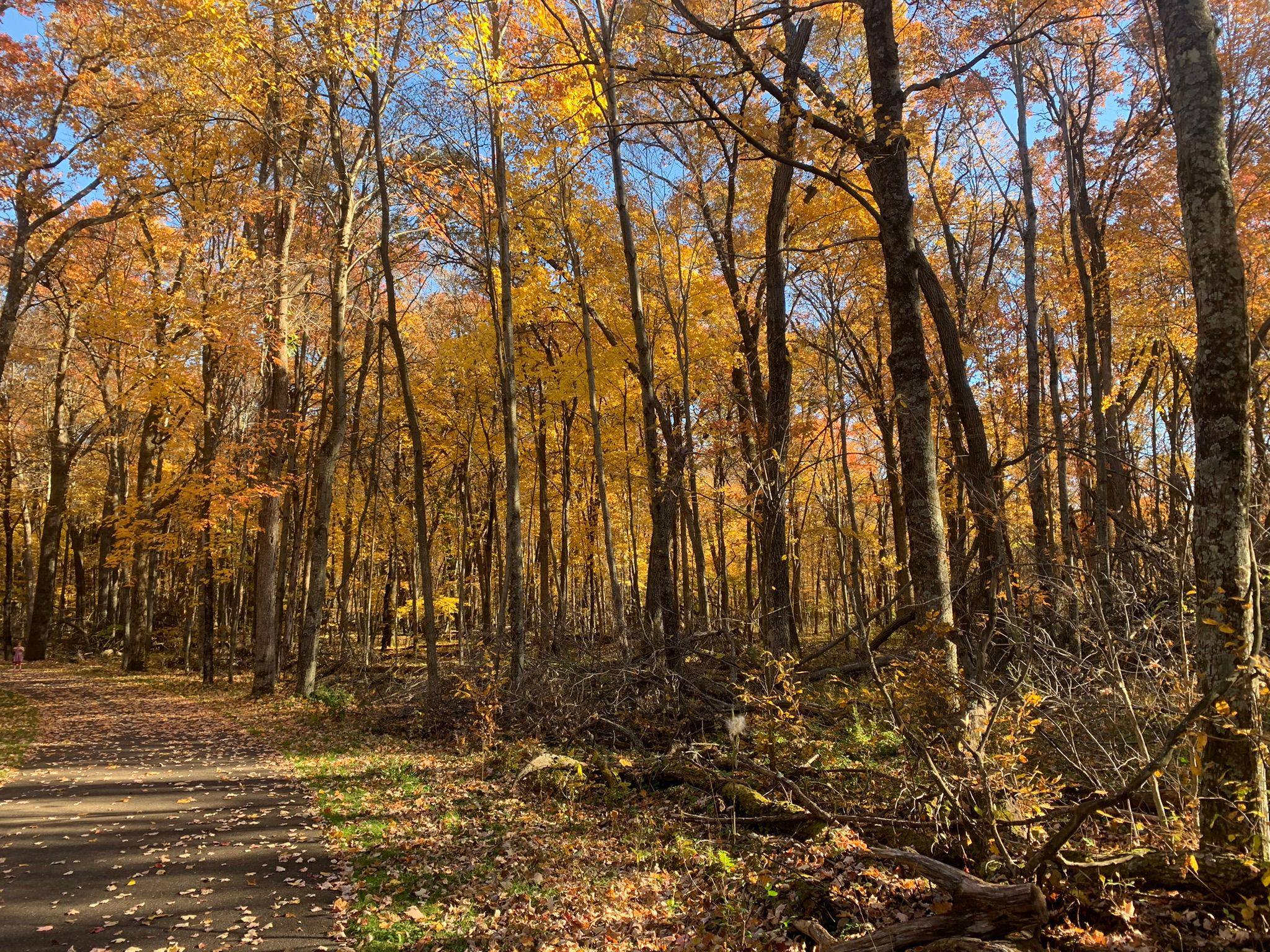
Top fall color hikes around North Branch MN

Wild River State Park, North Branch, Minnesota
There’s no better way
to experience autumn colors in the North Branch area than a
hike.

The brilliant yellows, oranges and red of maples to the scarlet
and russets of oaks...
the crisp, fresh autumn air and the last warm rays of sunlight before winter arrives...the crunch of fallen leaves and acorns beneath your boots...stopping to enjoy a warm mug of apple cider or a caramel apple pulled from your backpack – it all calls for an afternoon on the trail.

Fortunately, there are plenty of great autumn trails around North Branch to hike. Some are right out your back door, while some are a day trip that you can do in an afternoon.

Wild River State Park (North Branch)
Silver maple and basswood flourish along the St. Croix River at Wild River State Park. The 1.5-mile River Terrace Loop and its stem trail circles through a bottomland forest in this popular park. Originally called St. Croix Wild River State Park – and it still appears on various maps that way – it’s now just Wild River State Park. From North Branch, take Minn. Hwy. 95 to County Road 12. Drive County Road 12 to the park entrance, and follow the main park road to a parking lot near the picnic area.
***
Autumn colors abound in the floodplain forest at Wild River State Park. The 4.6-mile Sunrise Loop in the park’s north side is little used and so offers lots of solitude as it runs along the St. Croix River. Silver maple, ash, black willow and cottonwood all thrive there. From North Branch, take Minn. Hwy. 95 east/south. Turn left/north on County Road 9, taking it into the hamlet of Sunrise; from there, turn right/north on Ferry Road into the park. When the road runs out, use the parking lot on the left/west. Hike Ferry Road south to the trailhead and cross Ferry Road (which leads to the boat landing) then over the Sunrise River footbridge. On the other side of the bridge, the loop begins.

Minnesota Interstate State Park (Taylors Falls)
The southernmost section of Minnesota Interstate State Park offers a number of great day hiking trails to explore the Dalles of the St. Croix. To reach the area, from U.S. Hwy. 8 in Taylors Falls, turn east onto Milltown Road. A parking lot is at the end of the entry road. Along the parking lot’s northwest side are three trailheads. The Sandstone Bluff Trail heads northwest under Hwy. 8 to a nice vista of the valley and river gorge below. A 1-mile lollipop trail, it’s spectacular in autumn with a mix of colors from the orange maples, red sumac and brilliant yellow oaks.

Swedish Immigrant Trail (Shafer)
Hikers can follow some of the same footpaths and rail lines that the region’s first Swedish immigrants used to settle Chisago County and Minnesota on the Swedish Immigrant Trail. During the late 1800s, many Swedish immigrants took the ferry across the St. Croix River and then footpaths to their destinations. A spur off the St. Paul-Duluth rail route to Wyoming opened during 1880, helping speed the immigration inland. Perhaps the best of the trail’s completed portions is the Shafer Segment, which runs roughly west of the hamlet through wooded areas and past bucolic landscapes. Birch trees dominate in some sections, but the trail is mainly lined by mixed hardwoods that leave the path and its grass shoulders covered in an array of colorful leaves during autumn. Park on the street in downtown Shafer, off of Redwing Avenue near 303rd Street. The trailhead is near 303rd and heads for about two miles east of Redwing. Look for the white signs with the trail logo in the blue and yellow colors of Sweden’s flag.

Wisconsin Interstate State Park (St. Croix Falls, Wis.)
The splendor of fall colors combines with a vista of the St. Croix River and fascinating rock formations on the Summit Rock Trail at Wisconsin Interstate State Park. The 1-mile round trip trail heads to a bluff’s highest point. Moss and autumn leaves cover the surrounding rock and ground while maples, basswood and eastern white pines line the trail. At the top, prickly pear cactus can be spotted amid the outcroppings. The highlight of the hike without question is the incredible view of the riverway from the summit. Looking north, the Old Man of the Dalles rock formation is visible. From St. Croix Falls, take Wis. Hwy. 35 south. Turn right/west into the park and follow the entry road to the parking lot across from the Lake O’ the Dalles.

St. Croix National Scenic Riverway (Osceola, Wis.)

Fantastic river views beneath a colorful forest canopy await hikers on the this pair of trails near Osceola. Not to be confused with Ridgeview Trail at the adjacent Osceola Bedrock Glades State Natural Area, this pair of trails actually are two loops that only locals really know about. They run through the St. Croix National Scenic Riverway and the Osceola State Fish Hatchery on a bluff overlooking a St. Croix River back channel. The oranges and reds of maples dominate here with the occasional pine grove.

Big Marine Park Reserve (Forest Lake)
Hikers can enjoy a walk through a woodlands and on long pier at Big Marine Park Reserve. The unnamed trail in the Washington County park runs 0.75 miles round-trip. The turf trail leaves from the park’s western side, entering a deciduous forest, which makes for a colorful walk among yellow, orange, red, russet and olive leaves in autumn. From Forest Lake, take Minn. Hwy. 97 east. Turn left/south onto County Road 15/Morning Trail North. The park entry road (aka Lomond Trail North) is on the left/east. When the entry road splits, go straight/west, following it to the last/northernmost parking lot (the road loops back onto itself at the lot).


Saturday, January 2, 2016

Consider family hike at Interstate state parks

Dalles of the St. Croix, from Wisconsin Interstate State Park
At Wisconsin or Minnesota’s Interstate State Park, you can experience the results of the three most significant geological events to affect these pair of states: billion-year-old lava flows, the sands of a 500-million-year-old tropical sea, and a massive glacial flood from 10,000 years ago.

The twin parks mark a unique arrangement – it runs in two states along both sides of the ancient gorge known as the Dalles of the St. Croix. The two sides are run independently of one another by each state’s Department of Natural Resources. In addition, they border two entities operated by the National Park Service – the St. Croix National Scenic Riverway and the Ice Age National Scenic Trail, the latter of which actually enters the Wisconsin park.

That so many parks and trails populate this area is no surprise. Few locales in the Upper Midwest match the Dalles of the St. Croix’s scenic beauty: a pristine blue river running through a gorge sided by black lava; fascinating multi-story sandstone formations; an utterly clear lake; extinct ancient riverbeds covered in ferns and wildflowers; glacial potholes that run dozens of feet deep.

The two state parks rank among the most visited in either state. The parks’ nearly 330,000 annual visitors exceeds that of several national parks.

Not surprisingly, the Wisconsin side is that state’s oldest park and Minnesota’s second oldest. During the 1890s, Harry D. Baker of St. Croix Falls, Wis., and George H. Hazard of Taylors Falls, Minn., spearheaded groups to preserve the area as parks. Minnesota established its park in 1895, and Wisconsin followed in 1900.

The parks really are 1.1 billion years in the making, though. The gorge wouldn’t exist if not for a major geological event dating that far back, when massive lava flows covered this region of the world. The hardened lava, or basalt, forms the bedrock that the St. Croix River and the surrounding valley and bluffs sit upon.

The rocks above it – and those that make up the park’s Old Man of the Dalles – were laid some 515 million years ago when this region sat under a warm shallow sea near the equator. As sediments piled up and were covered, they hardened over the eons into rock; the landscape finally rose above the sea about 345 million years ago.

Then about 10,000 years ago at the end of the last ice age, a glacial torrent swept through the area when ancient Lake Duluth drained south. This flood broke off the basalt in chunks, created the intriguing cliff formations, and gouged out the deep gorge that is now the river valley.

During the flood, giant eddies from the flow drilled holes into the landscape; these are the potholes near the river shore. The largest glacial potholes in the world sit in the Minnesota park.

Today, Interstate State parks find themselves at the center of a major outdoors recreational area. Thanks to the St. Croix National Scenic Riverway and several other nearby state parks and natural areas on both sides of the river, a number of impressive trails run through and near St. Croix Falls and Taylors Falls.

Dry and warm spring days, summer, and autumn for fall color season mark the best times to day hike the parks. They do remain open in winter, however, and when snow covered the river bluffs and rock formations offer a beauty reminiscent of the Rocky Mountains.

How to Reach the Parks
From Minneapolis-St. Paul, take I-35 north to U.S. Hwy. 8 in Forest Lake, Minn. Go east. Upon reaching Taylors Falls, the highway heads straight through the Minnesota park, with multiple access roads. Crossing the bridge into Wisconsin, take State Hwy. 35 south for a half-mile and turn right onto Park Road, which enters the Wisconsin park.

From Wisconsin, take State Hwy. 35 to St. Croix Falls, taking Park Road to the trails. To reach the Minnesota park, take Hwy. 35 to Hwy. 8; go west on the latter road, crossing the bridge into Minnesota and into the park. Hwy. 35 intersects I-94 in Hudson, Wis., for those traveling from southern Wisconsin or Illinois.

Hours and Admission
Wisconsin Interstate Park is open year-round from 6 a.m. to 11 p.m. A vehicle admissions sticker is required. Because Wisconsin Interstate State Park is part of the Ice Age National Scientific Reserve, any of the National Parks and Federal Recreational Lands Pass Series also will get you in.

Minnesota Interstate State Park is open year-round from 8 a.m. to 10 p.m. A state park pass is required.

Parking
Several lots are available at both parks. In the trail descriptions that follow, the best parking lot for each trailhead is provided.

Facilities
Both parks offer several activities that perfectly complement a day hike. Among them are camping, swimming, picnicking, rock climbing, and fishing.

In addition, each park boasts a visitor center. At the Wisconsin park, the Ice Age Interpretive Center through displays and murals focuses on the Dalles’ geological history with a 20-minute movie available upon request; the center is open daily from 9 a.m. to 4 p.m. The Minnesota park’s visitor center focuses on the area’s history and resources; hours vary by season. Both centers include gift shops.

Dogs
Dogs are allowed at both parks but must be personally attended to at all time and kept on a leash (six feet maximum in Minnesota and eight feet maximum in Wisconsin). Dog waste always must be picked up. In the Wisconsin park, a dog walk area is southwest of the River Picnic Shelters where Dalles Creek flows into the St. Croix River.

Trails
Minnesota
g River Trail
g Shadow Rock Lookout Trail
Wisconsin
g Ladder Tank Trail
g Pothole Trail
g Rock Creek Trail
g Summit Rock Trail

Read more about day hiking Interstate State Park in my Hittin' the Trail guidebook.


Thursday, July 3, 2014

Easy to reach St. Croix National Scenic Riverway offers diversity of day hiking trails

St. Croix River shoreline near campsites north of Danbury, Wis.

Adventure awaits
in nat. park unit


A quick travel quiz: Name the national park unit where you can lean against 200-year-old trees, feel the splash of a hidden waterfall, retrace the steps of historic portages, watch bald eagle families soar overhead, walk across billion-year-old rock, and pick apples as autumn leaves turn red and golden.

Yosemite National Park? Nope. Yellowstone? Nuh-uh. Cuyahoga Valley? Sorry, still wrong.

The correct answer: The St. Croix National Scenic Riverway.

Covering more than 250 miles of shoreline, the National Park Service unit straddles the Minnesota-Wisconsin border and includes both the St. Croix and Namekagon rivers. Seven state parks and several state forests, county parks, and nature centers are in the scenic riverway.

Just a few hours’ drive at most for anyone living in Minnesota, Wisconsin, northern Illinois, Iowa, and Michigan’s Upper Peninsula, the scenic riverway’s proximity to the Minneapolis-St. Paul International Airport makes it easier to reach than most national parks. Indeed, the scenic riverway outperforms more than half of all national parks in attendance.

200-year-old trees
Last year, I spent six months hiking 40-plus trails in the riverway as researching my latest book, “Hittin’ the Trail: Day Hiking the St. Croix National Scenic Riverway.” I initially expected to find that every trail was the same: a path through a Northwoods forest with river views. Was I ever wrong.

The St. Croix River begins north of Solon Springs, Wis., where the Bois Brule-St. Croix River Historic Portage Trail runs 4.4-miles round trip. The trail is the same route crossed centuries ago by Daniel Greysolon Sieur duLhut, a French explorer who opened the way for fur traders in the 1680s.

South of there, the St. Croix meets its main tributary, the 101-mile Namekagon River. A plethora of great day hiking trails wind alongside the Namekagon. The Wild Rivers Trail, in Trego, Wis., crosses the waterway on an old railroad bridge near the park service’s Namekagon Visitor Center.

A few miles below the St. Croix-Namekagon confluence is Governor Knowles State Forest. There the Cedar Interpretive Trail heads through a grove of stately eastern white cedar. The cedars that are a foot in diameter were mere saplings during the War of 1812.

Old Man of the Dalles
At Wisconsin Interstate State Park, the Summit Rock Trail climbs to a scenic overlook of the St. Croix River and the Old Man of the Dalles rock formation, which looks like an elderly man’s face. The trail crosses volcanic rock from 1.1 billion year-old lava flows. Families of bald eagles families searching for a meal in the river glide about the summit, sometimes coming within a few feet of hikers.

In nearby St. Croix Falls, Wis., the St. Croix River Visitor Center boasts a 500-gallon aquarium and presents an award-winning film about the riverway. Events featuring authors and artists often are held there.

Day hikers can walk alongside the multi-level Willow River Falls at Willow River State Park east of Hudson, Wis. The rock on the gorge walls’ lowest levels is about 600 million years old.

Apple picking during autumn highlights the stop at the privately-run Carpenter Nature Center. The center sits on the Minnesota side of the riverway close to where the St. Croix flows into the Mississippi River.

Read more about day hiking the scenic riverway in my guidebook Hittin’ the Trail: Day Hiking the St. Croix National Scenic Riverway.


Sunday, February 23, 2014

Hike scenic lake that once was part of river

Lake O' the Dalles Trail runs
for mile in Wisconsin state park


Families can hike around and even swim in a lake that once was part of the St. Croix River at Wisconsin Interstate State Park.

The Lake O’ the Dalles Trail circles its namesake, a 23-acre lake, in a 1-mile loop. Nicely lined with hardwood trees, the trail is relatively flat with a few stairs.

To reach the state park, from St. Croix Falls, Wis., at the junction of Wis. Hwy. 35 and U.S. Hwy. 8, travel south on Hwy. 35. In half a mile, turn right to enter the park. Follow the park road down the hill to a parking lot on the left/east side. The trailhead is on the lot’s north side; head left/west onto the trail, passing the picnic area.

Where the river once ran
During the past 10,000 years, the St. Croix River has changed its course several times. The small ravines across the park indicate where it once ran. During those course changes, the river hollowed out this backwater lake; sediment then filled in the space between it and the St. Croix’s current course. No more than 12 feet deep, the Lake O’ the Dalles’ bottom is about 99 percent rock.

After the trail circles the lake’s north side, it comes to a junction with Echo Canyon Trail. Continue paralleling the lake.

Despite being cut off from the main channel, the picturesque lake recently has been invaded by the non-native curly-leaf pondweed. Originally from Eurasia, the plant lives from the shoreline to depths of up to 15 feet in lakes, where it can displace native plants. It’s a problem across the Great Lakes states.

The next two trail junctions are for the River Bluff Trail. The Lake O’Dalles Trail can be extended by hiking the River Bluff Trail, a 0.7-mile loop that takes hikers between the St. Croix River gorge and the Lake O’ the Dalles. The rocks and sparse vegetation gives it a Rocky Mountain feel. If adding that loop, the hike’s total length is about 1.6 miles.

The next highlight along the lake trail is a railed fishing pier that you can walk onto. You’ll often find anglers here catching largemouth bass, northern pike, panfish and walleye from the lake.

Wildlife viewing trail
As following the trail around the lake’s west side, the River Bottoms Picnic Area is to the west next to the St. Croix River. Along this side of the lake, about 40 yards of the trail follows the park road.

A footbridge then crosses Dalles Creek as the trail loops back around the lake’s south side.

An excellent trail for spotting wildlife, you stand a good chance of seeing white-tailed deer or fox near the lake. Eagles and osprey also are likely as they circle overhead looking for a meal. More rarely, black bear have been spotted plodding about nearby.

The trail then heads up the lake’s eastern side to the stone Beach House. The CCC and WPA constructed the rustic building during the Great Depression. A swimming beach is located here. The beach house is near the trailhead, with your parking lot in clear view.

Read more about day hiking Interstate State Park in my Hittin’ the Trail: Day Hiking Wisconsin and Minnesota Interstate State Parks guidebook.


Thursday, September 5, 2013

Great parks, trails await Polk County hikers

An outdoor recreational paradise, Polk County is full of trails to hike or ski, lakes to fish or boat, geological sites to marvel at or explore. For day hikers, a number of major parks and standalone trails can be found in the county.

Parks
The St. Croix National Scenic Riverway runs the length of Polk County’s western side. Its visitor center in downtown St. Croix Falls boasts a 500-gallon freshwater aquarium.

The county also is home to two state parks – Wisconsin Interstate State Park and Straight Lake State Park. Interstate Park sits in the famous Dalles of the St. Croix gorge while Straight Lake, near Luck and Frederic, is deliberately undeveloped to serve those seeking a truly back to nature experience.

Another great state-owned land to hike is the Osceola Bedrock Glades State Natural Area. It sports a rare plant ecosystem that resides on and around 1.1-billion-year-old volcanic rock.

Trails
Ice Age National Scenic Trail finds its western terminus in St. Croix Falls. The trail largely parallels the southernmost advance of the glacier that last covered Wisconsin some 10,000 years ago.

Several old railroad beds have been converted into trails as well. They’re very popular among backpackers and day hikers alike. The four railroad trails are:
g Gandy Dancer Trail Starting in St. Croix Falls, the trail connects several communities on its 98-mile course north to Superior.
g Stower Seven Lakes State Trail The 14-mile trail runs past lakes and farmland west of Amery.
g Cattail State Trail The 18-mile trail also leaves from Amery but heads east to Turtle Lake and Almena in neighboring Barron County.
g Clear Lake-Clayton State Trail Linking its namesake communities, the trail runs for 11 miles. Note that the railroad beds have a strict carry-in, carry-out policy.

Read more about day hiking this and nearby trails in my Hittin’ the Trail: Day Polk County, Wisconsin guidebook.


Sunday, August 25, 2013

Kid-friendly trails start at Ice Age Center

The Ice Age Interpretive Center is a great place to begin
(or end!) a day hike at Wisconsin Interstate State Park.
Two day hiking trails can be taken from Wisconsin Interstate State Park’s Ice Age Interpretive Center, offering impressive sites.

After heading through the entrance gates, park at the interpretive center, which is on the left. One trail heads away from the center while the other begins at the building.

The westernmost steps of the Ice Age National Scenic Trail end with the park’s 0.5-mile Horizon Rock Trail, which runs from the Ice Age Visitor Center to Pothole Trail. From the center, you’ll pass a historic stone shelter, known as Historic Rock, offering a panoramic view of the river gorge below. From there, the trail descends the forested bluff to a creek bed that instantly will cool you on humid days.

Horizon Rock Trail can be extended by taking a couple of different trails:
g Talus Slope Trail-Meadow Valley Trail – A steep switchback, the Talus Slope Trail links the Horizon Rock Trail to the 0.3-mile Meadow Valley Trail. Meadow Valley crosses through ferns, mosses and various wildflowers on what is now an extinct riverbed carved by glacial meltwaters during the last ice age. The trail ends at the beach party parking lot.
g Pothole Trail – When floodwaters from melting glaciers swept through at the end of the last ice age, swirling water literally drilled holes into the basalt rock underlying this region. The 0.4-mile loop takes you past a number of these interesting geological features.

The Skyline Trail runs for 1.6 miles (3.2 miles round trip) southwest from the center to the Pines Group Camp. It first passes the Skyline Nature Trail and then the Ravine Trail. From there, the trail ascends rock-covered ravines to the valley’s forested rim. Wooden benches are along the way.

The Skyline Trail can be extended by taking a couple of spur trails:
g Skyline Nature Trail –The 0.75-mile trail loops though several plant communities. Interpretive signs describe how the plant communities differ as the landscape changes. The Ice Age National Scenic Trail runs east from the loop behind the visitor center toward the park entrance.
g Ravine Trail – The 0.5 mile trail climbs 260 feet from the valley rim to a shelter, the amphitheater, and a picnic area at the beach parking lot.

The Skyline Trail also can be extended at its southern terminus by taking two connecting trails:
g Eagle Peak Trail – The trail takes you to the park’s highest point, Eagle Peak. Though short at 0.8 miles, it climbs 120 feet in elevation, including up stone stairs. The trailhead begins at the Pines Group Camp. A short side trail passes a traprock quarry built by the CCC during the 1930s on its way to South Campground.
g Silverbrook Trail – To get away from the park crowds, take this 1.2-mile (2.4 miles round trip) trail to the remote, forested southern end. The trail in part follows the original road that connected the village of Osceola to the south with St. Croix Falls to the north. It passes an abandoned copper mine, the Silverbrook Mansion grounds, then reaches the trail’s highlight: 18-foot Silverbrook Falls. There’s an observation point and bench at the falls.

Read more about day hiking Interstate State Park in my Hittin’ the Trail: Day Hiking Wisconsin and Minnesota Interstate State Parks guidebook.


Thursday, August 22, 2013

Explore Interstate State Park’s ‘urban’ trails

A section of downtown St. Croix Falls sits within Wisconsin Interstate State Park and offers a short albeit interesting day hiking trail ideal for little children.

The Ladder Tank Trail can be reached without having to enter the park via the road. Park along Washington Road between U.S. Hwy. 8 and Kentucky Street; the trailhead is on the road’s west side.

The trail runs atop a tall ridge of sediment left by the meltwater of a retreating glacier that was last seen in these parts some 10,000 years ago. The ridge offers fantastic views of the St. Croix River with visibility of up to eight miles on clear days.

While not technically in Interstate State Park, the Ladder Tank Trail can be extended by taking the brief Gaylord Nelson Riverwalk from the overlook to the St. Croix National Scenic Riverway Visitors Center.

Read more about day hiking Interstate State Park in my Hittin’ the Trail: Day Hiking Wisconsin and Minnesota Interstate State Parks guidebook.


Friday, August 16, 2013

Family-friendly day hiking trails explore remote section of Wisconsin Interstate Park

You can explore Wisconsin Interstate State Park’s southern section via three day hiking trails. After entering Interstate via Park Road, follow it to the Pines Group Camp parking lots. The trailheads are at the road’s end and the southernmost of the two parking lots.

Eagle Peak Trail takes you to the park’s highest point, Eagle Peak. Though short at 0.8 miles, it climbs 120 feet in elevation, including up stone stairs. The trailhead begins at the Pines Group Camp. A short side trail passes a traprock quarry built by the CCC during the 1930s on its way to South Campground.

To get away from the park crowds, hike the 1.2-mile trail (2.4 miles round trip) Silverbook Trail. It runs to the park’s remote, forested southern end. The trail in part follows the original road that connected the village of Osceola to the south with St. Croix Falls to the north. It passes an abandoned copper mine, the Silverbrook Mansion grounds, then reaches the trail’s highlight: 18-foot Silverbrook Falls. There’s an observation point and bench at the falls.

The Skyline Trail runs for 1.6 miles (3.2 miles round trip) northeast to the Ice Age Visitor Center. From the valley’s forested rim, the trail descends through rock-covered ravines. It first passes the Ravine Trail and then the Skyline Nature Trail junctions. Wooden benches are along the way.

The Skyline Trail can be extended by taking a couple of spur trails:
Skyline Nature Trail –The 0.75-mile trail loops though several plant communities. Interpretive signs describe how the plant communities differ as the landscape changes. The Ice Age National Scenic Trail runs east from the loop behind the visitor center toward the park entrance.
Ravine Trail – The extremely short trail runs to a shelter, the amphitheater, and a picnic area at the beach parking lot.

Read more about day hiking Interstate State Park in my Hittin’ the Trail: Day Hiking Wisconsin and Minnesota Interstate State Parks guidebook.


Saturday, August 10, 2013

Kid-friendly trails explore Interstate S.P.

Dalles of the St. Croix at Wisconsin Interstate State Park.
The heart of Wisconsin Interstate State Park’s can be explored on day hikes through a series of connecting trails.

Take the park entrance road to the parking lot to the Lake O’ the Dalles beach parking lot. From there, you have the choice of two trails.

Summit Rock Trail heads to the bluff’s highest point and is a dirt surface, so expect an uneven and steep walk at times. Small sections of the 0.5-mile trail (one way) consist of stone and wooden steps through the forested area. The highlight of the hike without question is the incredible view of the riverway from the summit. Looking north, the Old Man of the Dalles rock formation is visible just beyond glacial potholes.

Taken clockwise, the Eagle Canyon Trail links the Summit Rock and the Lake O’ the Dalles trails in a 0.7-mile loop. The trail crosses an ancient riverbed that glacial meltwaters carved out of the landscape at the end of the last ice age. If the day is hot, you’ll instantly feel cool down on the Eagle Canyon Trail as the nearly sheer, talus canyon walls moderate the temperature. There are some stone stairs, and the trail can be steep at spots.

The route briefly shares a segment of the Lake O’ the Dalles Trail, a one-mile loop circling the 23-acre Lake O’ the Dalles. The trail offers exceptional opportunities to view wildlife.

The Lake O’Dalles Trail can be extended by taking two connecting paths:
River Bluff Trail – This 0.7-mile trail in takes hikers between the St. Croix River gorge and the Lake of the Dalles. The rocks and sparse vegetation gives it a Rocky Mountain feel.
Camp Interstate Shelter connector – The short path heads southeast to a reservable shelter and a picnic area.

Read more about day hiking the scenic riverway in my guidebook Hittin’ the Trail: Day Hiking the St. Croix National Scenic Riverway.


Tuesday, July 23, 2013

Wisconsin state park gift store carrying author's 'Headin' to the Cabin'

Glacier Gifts, the gift store at Wisconsin Interstate State Park's visitor center, is now carrying my book, Headin' to the Cabin: Day Hiking Trails of Northwest Wisconsin. Headin’ to the Cabin describes more than a 100 day hiking trails in Ashland, Barron, Bayfield, Burnett, Douglas, Polk, St. Croix, Sawyer and Washburn counties, including several in Interstate State Park. The park is located off of Wis. Hwy. 35 south of U.S. Hwy. 8 in St. Croix Falls.

Read more about family friendly day hiking trails in my Headin' to the Cabin guidebooks.


Saturday, July 20, 2013

St. Croix 360 features excerpt from ‘Hittin’ the Trail’ guidebook

St. Croix 360 on Thursday ran an excerpt from my recent release, the ebook Hittin’ the Trail: Day Hiking Polk County, Wisconsin. The excerpt is a description of the Summit Rock Trail, just north of St. Croix Falls, in Wisconsin Interstate State Park. St. Croix 360 covers environmental, outdoors and other news related to the scenic riverway. Day Hiking Polk County, Wisconsin lists dozens of great family-friendly trails in or near all of your favorite Polk County communities, including St. Croix Falls, Osceola, Amery, Turtle, Frederic, Luck, and Balsam Lake.

Find out about other trail guidebooks available in the Hittin’ the Trail series.


Wednesday, June 26, 2013

Great Ice Age Trail routes in St. Croix Falls

Horizon Rock Trail
Some 10,000 years ago, much of Wisconsin lay beneath a towering glacier. The glacier crushed and flattened the landscape, and remnants of it formed many of the lakes seen across the county and northern Wisconsin by depressing the land and melting. The Ice Age National Scenic Trail runs nearly 1200 miles across the state – with its western end at St. Croix Falls – largely tracing the extent of the glacier during the most recent ice age.

From its western edge at Wisconsin Interstate State Park, the trail runs through St. Croix Falls north along the St. Croix National Scenic Riverway. It then heads east along 100th Avenue, paralleling and crossing State Hwy. 35 near the small village of Centuria. Several of these Ice Age Trail segments near St. Croix Falls make for great day hikes:
Interstate State Park section – The westernmost steps of the Ice Age National Scenic Trail end with the park’s 0.5-mile Horizon Rock Trail, which runs northwest between the Ice Age Visitor Center and the Pothole Trail. From the center, you’ll pass a historic stone shelter, known as Historic Rock, offering a panoramic view of the river gorge below. From there, the trail descends the forested bluff to a creek bed where you’ll instantly cool off on humid days.
 Esker Trail – This short trail runs atop a tall ridge of sediment left by the meltwater of the retreating glacier. The ridge offers fantastic views of the St. Croix River with visibility of up to eight miles on clear days.
 Mindy Creek Ice Age Trail Segment – Starting with a blufftop view of the St. Croix River Valley, the trail runs through a ravine boasting boulders and interesting rock formations left here during the last age. Access the trail from Day Road, about 0.8 miles from the Louisiana Street junction; park at Zillmer Park off of Day Road.
 Riegel Park Ice Age Trail Segment – The trail runs through the village’s 76-acre Riegel Park Preserve. A trap rock meadow of moss and lichen with scattered trees covers the preserve.
 Indianhead Flowage Trail – Walk atop billion-year-old volcanic rock surrounded by the deep blue of the St. Croix River and the lush green of the Northwoods forest on this 1.5-mile trail.

Read more about day hiking the scenic riverway in my guidebook Hittin’ the Trail: Day Hiking the St. Croix National Scenic Riverway.