Showing posts with label Two Rivers. Show all posts

Sunday, February 11, 2018

Hike to one-of-a-kind Great Lakes lighthouse

Rawley Point Light and the keeper's residence on Lake Michigan.
Map of walk to Rawley Point Light. Click for larger version.
Day hikers can explore the grounds of the only skeletal lighthouse of its kind on the Great Lakes just north of Two Rivers, Wisconsin.

The walk to the Rawley Point Light is a brief 0.15-miles round trip. Access to a Lake Michigan beachfront also is available.

To reach Rawley Point, from the intersection of Wis. Hwy. 42 and County Road O (22nd Street) in Two Rivers, take County O east/north. After passing Point Beach State Forest, turn right/east onto Park Road. Leave your vehicle in the lot on the road’s right/south side just before it curves north. Go to the lot’s east side and walk the trail heading right/south.

After passing through a small grove, the trail opens up to the lighthouse grounds with the beach and Lake Michigan beyond.

Long history of lighthouses
Standing 113-feet high, the lighthouse isn’t your standard brick or sandstone structure that make up so many of Wisconsin’s charming light stations. This light instead is the octagonal skeletal structure of the 1859 Chicago Harbor Light, which was dismantled and then reconstructed on the point in 1894.

The lighthouse and point is named for Peter Rowley, who set up a trading post nearby in 1835. A 1888 government records misspelling of his name led to the current use of “Rawley” rather than “Rowley.”

Records are not entirely clear, but a 75-foot tall light consisting of four poles and a lantern is thought to have been erected on the site in 1853. A wooden tower and house was built soon after. Because the wooden tower was in a poor location, though, a brick structure was constructed in 1874. This tower proved to be structurally unsound, however, so it was replaced with the current lighthouse. Trusswork was added to the steel tower’s base to increase the height, a new service room below the lantern was built, and a better lens installed.

The current lighthouse effectively ended shipping accidents on the dangerous shoals around Rawley Point. Prior to it, 26 ships foundered or were left stranded on the point. In 1887, the steamship Vernon sunk nearby, drowning 36 crew members and passengers.

Name change
The lighthouse was known as Two River Point Light until 1956, when it was given its current name. In 1962, a fire destroyed part of the residence. Then in 1979, the lighthouse was automated.

It continues in service today with Coast Guard personnel using the residence. The light can be seen up to 19 miles away and operates a half-hour before sunset until a half-hour after sunrise.

Tours of the lighthouse are not available, but on occasion self-guided tours of the residence are.

After taking in the lighthouse grounds, feel free to walk to the beach and dip your feet into Lake Michigan’s cold waters. The beach stretches about 300 feet from the lighthouse to the lake, so this can at least double the distance of the hike to a minimum of 0.3-miles round trip.


Sunday, September 17, 2017

Trail crosses ancient great lake beach ridge

Autumn colors line the forest at Woodland Dunes Nature Center and Preserve.
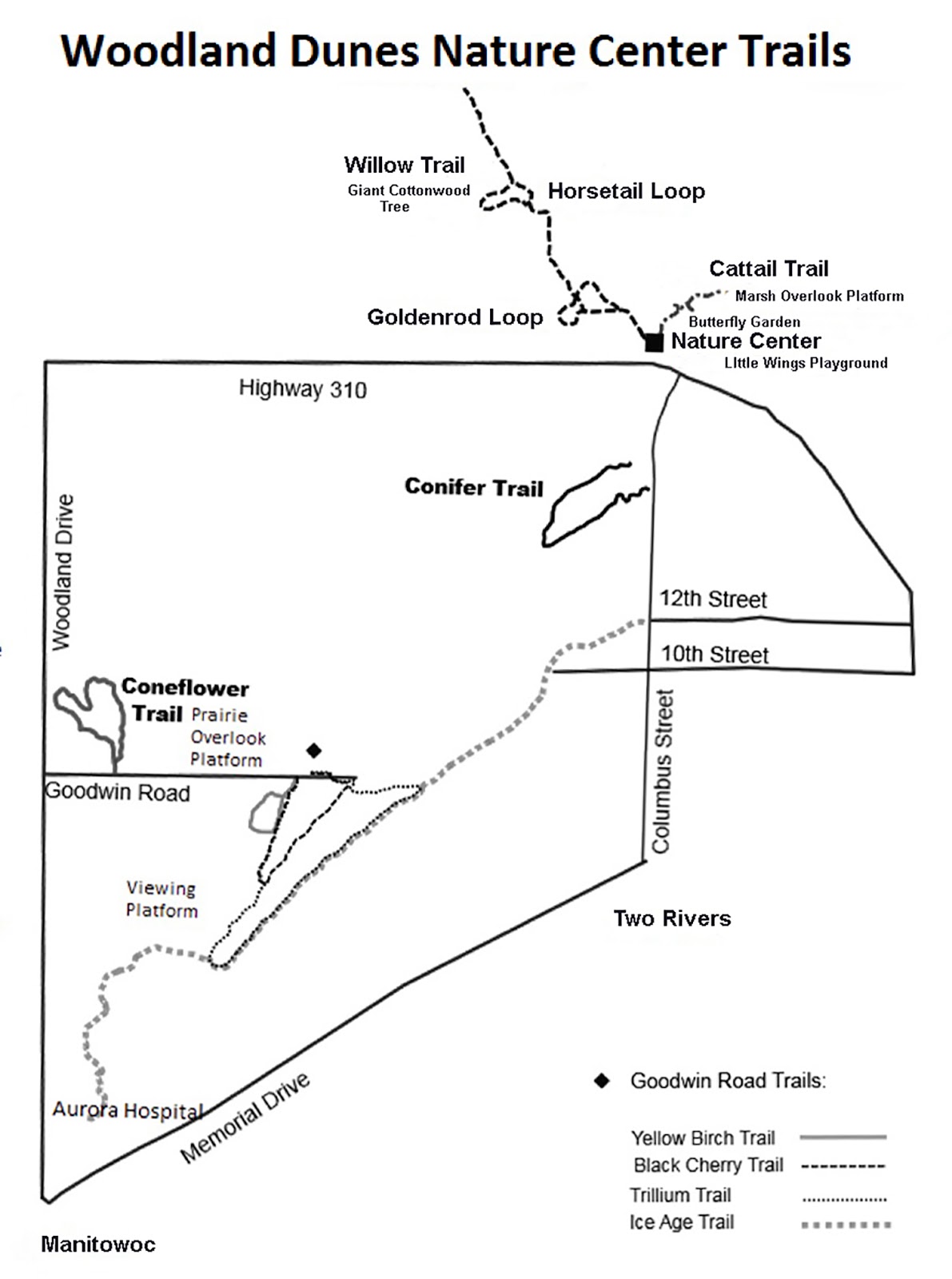
Conifer Trail map. Click for larger version.
Hikers can walk upon what 5000 years ago was a Lake Michigan beach ridge in Wisconsin.

The 0.5-mile Conifer Trail at Woodland Dunes Nature Center and Preserve located near the great lake between Manitowoc and Two Rivers. Entirely wooded now, it makes for a great autumn hike.

To reach the trailhead, from Manitowoc take Wis. Hwy. 42 north toward Two Rivers. Turn left/north onto Columbus Street and left/west onto Wis. Hwy. 310. If in Two Rivers, take Hwy. 310 west toward Interstate 43. Immediately after Columbus Street, turn right/north into the preserve’s nature center and park there. To reach the trailhead, head south alongside Columbus Street; a sign identifies the trailhead, about two blocks from the nature center, on the road’s west side.

The looping trail follows two ancient beach ridges – elevated areas of sand and sediment swept there by waves. It crosses a swale – a low-lying area – between the ridges.

But how can there be beach ridges when Lake Michigan is more than a half-mile away?

These are ancient beach ridges and swales, remnants from a time with Lake Michigan was larger. In fact, it wasn’t exactly Lake Michigan then but Lake Nipissing.

As the heavy glaciers retreated some 10,000 years ago, the depressed crust of North America rebounded. The result was higher levels in Lake Nipissing, which is basically today’s Lake Michigan, except 30 feet higher. This inundated low-laying land to the lake’s east and south. Breaking waves bulldozed the lake’s sandy bottom, creating a series of parallel underwater ridges and troughs.

Gradually water drained from Lake Nipissing, and the shoreline retreated. As it did, those underwater ridges and troughs became above water sand dunes and swales. Plants common to beach dunes kept these ridges and depressions in place. Over the centuries, shrub carr replaced the dune plants, paving the way for forests to take root and grow.

Today, a mixed hardwood-conifer forest covers the Conifer Trail’s beach ridges and swale. Signs along the trail point out the different types of trees, with the hardwoods consistently mainly of beech, sugar maple, basswood, red and white oak.

That makes for a splendid autumn display – the bronze of American beech, the yellows, oranges and reds of sugar maple, the brown of red oak and the scarlet of white oak, all mixed with the olive leaves of basswood and evergreen needles of the conifers.

The beech trees are particularly interesting as they primarily grow in hardwood forests along Lake Michigan and are absent in most of the rest of Wisconsin. The American beech grows up to 60-75 feet high and boasts a broad, oval canopy. They prefer organically rich, acidic, loamy soils, common along Lake Michigan.

After completing the loop, walk left/north along Columbia Street and return to the nature center.