Showing posts with label Alaska. Show all posts

Thursday, September 8, 2016

3 Must-Do Day Hikes in Alaska

Bear hunting salmon on Brooks Falls Trail at Katmai National Park.
Visiting an Alaska national park? Be sure to include these three short trails on your itinerary!

Beach Trail

Glacier Bay National Park
Families can encounter an array of marine wildlife on the Beach Trail at Glacier Bay National Park. The 1.5-mile round trip runs along Bartlett Cove in southeastern Alaska. There are only four trails total at the park, and children generally will find this the most interesting of them. Memorial Day through Labor Day weekends mark the best time to visit the park.

Brooks Falls Trail
Katmai National Park
Day hikers can watch gigantic brown bears fish for salmon on the Brooks Falls Trail at Katmai National Park. While the oft-photographed and filmed falls is the highlight of the 2.4-miles round trip out-and-back trail, getting to the national park is an adventure in itself. No roads lead to it, so you either must take a boat or air taxi, which requires advance planning and reservations several months in advance. July and the first half of September mark the best time to see fishing bears and to enjoy the fall slate of park services.

Horseshoe Lake Trail
Denali National Park
Though known for its backcountry trails through an expansive wilderness, Alaska’s Denali National Park offers natural quiet and the opportunity to spot wildlife right near its entrance. The 1.5-mile Horseshoe Lake Trail is one such day hike. An out-and-back trail, it runs 3-miles round trip.

BONUS: Best trails for seeing Glacier Bay’s wonders
Among the best ways to see Glacier Bay National Park’s top sights is via a day hike. Just a couple of short trails will allow you to spot some of the park’s marine animals and large North American land mammals. No hiking trails lead to the park’s famous tidewater glaciers, but many of them can be seen via cruise ship, tour vessel, chartered private boat, or accessed by sea kayak.

Learn more about national park day hiking trails in my Best Sights to See at America’s National Parks series.


Tuesday, October 21, 2014

Best trails for seeing Katmai N.P.’s wonders

Valley of Ten Thousand Smokes. Photo courtesy of Katmai NPS.

Iconic scene
of bears catching
salmon found
at Alaska park


Among the best ways to see Katmai National Park’s top sights is via a day hike. Just three short trails will allow you to enjoy each of the park’s highlights – bears catching salmon, a volcanic wasteland, and prehistoric sites.

Brown bears catching salmon
Every year more than 2,000 brown bears camp at Brook Falls to feed on spawning salmon, an iconic site made popular in photos and videos. The 2.4-miles round trip Brooks Falls Trail takes hikers to a safe observation platform where they can watch bears play on the beach or go fishing in the river.

Valley of Ten Thousand Smokes
A volcanic eruption in 1912 left several square miles of Alaska backcountry covered in deep ash. Though volcanic activity has subsided greatly since the 1930s, when thousands of fumaroles covered the valley floor, the region’s barren, moon-like landscape of hardened ash remains startlingly beautiful. Located 23 miles away from the park’s central area, you’ll have to ride a park bus there and then can go on a ranger-led 3-mile hike into the valley.

Prehistoric sites
The area near the Brooks River has been inhabited for thousands of years, as more than 900 depressions that once were homes and campsites attest. The Cultural Site Trail heads a short 0.1-miles past some of the sites while a ranger-led hike daily goes 0.25-miles daily on and near the trail to them.

Learn more about national park day hiking trails in my Best Sights to See at America’s National Parks guidebook.


Monday, September 15, 2014

Best trails for seeing Denali N.P.’s wonders

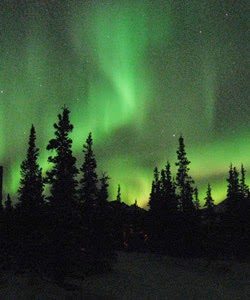
Aurora borealis at Denali National Park.
Photo courtesy of Denali NPS.
Among the best ways to see Denali National Park’s top sights is via a day hike. Just four short trails will allow you to enjoy each of the park’s highlights – North America’s tallest mountain, rare wildlife, an aurora borealis like you’ve never seen before, and a boreal forest.

North America’s tallest mountain
At 20,237 feet, Mount McKinley stands above any other peak on the continent, and the park is centered on it. You’ll need to be an mountain climber to ascend McKinley, but a 5-mile round trip day hike on the Wonder Lake Trail, leaving from the lake’s campground, offers great views of the mountain.

Rare wildlife
Caribou, Dall sheep, gray wolves, grizzly bears, moose, red squirrels, and snowshoe hares all call Denali home. A safe way to see them is via the Savage River Loop Trail, a flat 2-mile walk in which wildlife can be spoted on rocky slopes in the distance. Bring binoculars.

Aurora borealis
By mid-August through early September, Alaska’s skies are dark enough to see the enormous shifting streams of green and purple that occur when the solar wind interacts with the earth's atmosphere. Any spot in the park is good for watching them, but try one of the unnamed trails heading away from the Riley Creek Campground for a view of the northern lights dancing over a mountain range.

Boreal forest
Denali sits at the edge of a great northern (boreal) forest and the tundra. Aspen, birch and spruce dominate the woodlands here, and can be enjoyed via the Roadside Trail, a 3.6-mile hike.

Learn more about national park day hiking trails in my Best Sights to See at America’s National Parks guidebook.


Wednesday, July 9, 2014

Best trails for seeing Glacier Bay’s wonders

Black bears in Bartlett Cove. Photo courtesy Glacier Bay NPS.
Among the best ways to see Glacier Bay National Park’s top sights is via a day hike. Just a couple of short trails will allow you to spot some of the park’s marine animals and large North American land mammals.

No hiking trails lead to the park’s famous tidewater glaciers, but many of them can be seen via cruise ship, tour vessel, chartered private boat, or accessed by sea kayak.

Marine animals
Humpback whales, harbor seals, Minke whales, Pacific white-sided dolphins, orcas, sea otters, and Steller sea lions all can be seen at the national park. Take the extended shoreline hike from the Bartlett Cove dock along Beach Trail toward the campground (Beach Trail is a mile long and the extended trail goes up to 6 miles one-way); listen carefully for the blowback of humpback whales.

Large land mammals
The expansive national park is home to grizzlies, black bears, moose, Dall sheep, wolves, and a number of other species. To spot some of them, take the Bartlett River Trail for a 4-miles round-trip through a spruce/hemlock forest to a river estuary. Moose, black and brown bear, coyotes, and river otters usually can be seen along the beach; in late summer, harbor seals hunt salmon there.

Learn more about national park day hiking trails in my Best Sights to See at America’s National Parks guidebook.


Thursday, February 6, 2014

Spot starfish, humpbacks at Glacier Bay

A humpback whale flashes its tail in Glacier Bay.
Photo courtesy Glacier Bay NPS.
Beach Trail map, courtesy of Glacier Bay NPS.

Short shoreline day hike
offers opportunities
to see marine life


Families can encounter an array of marine wildlife on the Beach Trail at Glacier Bay National Park in Alaska.

The 1.5-mile round trip runs along Bartlett Cove in southeastern Alaska. There are only four trails total at the park, and children generally will find this the most interesting of them.

Memorial Day through Labor Day weekends mark the best time to visit the park. Summer temperatures generally will be in the mid-50s F. Still, even on this trail you’ll need wet weather clothing, specifically water-repellent footwear with good traction, raincoat/hat, and waterproof gloves. Also bring additional clothes that can be layered for the cooler mornings and evenings.

You won’t be able to drive to Glacier Bay, however, as the park is only accessible by air or water. A number of air services, commercial carriers, cruise ships, ferries, and tour boats do serve the park, which is about 65 miles north of Juneau, Alaska. This likely means that you’ll be staying overnight at Glacier Bay or making only a brief stop by boat.

The trail is ideal for those making such short visits as it can be picked up simply by heading southwest from the Glacier Bay Lodge and Visitor Center (1.5-miles round trip), the public docks (1.2-miles round trip), or the campground (0.5-miles round trip).

Sunrise over sea
Be sure to obtain a free tide schedule from a park ranger before hitting the trail. You’ll want to go at low tide and return before high tide sets in; if you don’t, you may be forced to hike through frigid water on the return walk.

Low tide also offers the opportunity to see intertidal life. As the waters retreat into the ocean – and water levels here can fall 25 vertical feet, among the greatest extremes in the world – a number of animals and plants are exposed. Don’t be surprised to spot starfish and snails on the sands and grasses.

During summer, low tide typically occurs in the morning. Sunrise usually is best for spotting marine life in the bay, so timing a hike at dawn with low tide is ideal.

During those first moments of sunlight, watch for humpback whales, harbor porpoise, puffins, sea otters, and Steller sea lions, frolicking and feeding in the mouth of the bay. Bring binoculars. If lucky, you’ll also hear the blow of humpback whales.

On shore, a variety of sea birds gather and fly over, often nabbing exposed intertidal creatures for a meal. Don’t be surprised if you see some large mammals, too – moose like to feed on the exposed grass while bears appreciate the water-free passageway.

Summer also brings one pesky creature to the intertidal flats – mosquitoes. You’ll need insect repellent on calm days.

Watch your time – and your step
While the icy blue waters of Bartlett Cove sit on one side of the trail, on the other side inland is a mature spruce and hemlock rainforest. Beyond that are the great glaciers that the park is named for. A mere 200 years ago, a glacier towered 4000 feet above the Beach Trail, stretching 10 miles wide and 100 miles long to the St. Elias mountain range. That glacier since has shrunk 65 miles from the shore, the fastest on record.

While the trail formally ends about a quarter mile from the campground, be aware that a footpath continues for several miles beyond. Keep track of your distance and time so that you don’t get stuck in high tide.

Because of the high amount of moisture, the trail usually is muddy, and anything on it – from wooden walkways and docks to tree roots and rocks – typically is slippery. Use handrails where available, and walk at a slow pace, watching your step.

After hiking the trail, be sure to check out the park’s visitor center, located on Glacier Bay Lodge’s second floor, for its exhibits about marine life. A Junior Ranger Program also is offered for children.

Learn more about national park day hiking trails in my Best Sights to See at America’s National Parks guidebook.


Saturday, February 1, 2014

Hike heads to former bend in subarctic river

Horseshoe Lake Trail runs

near Denali N.P. entrance


Though known for its backcountry trails through an expansive wilderness, Alaska’s Denali National Park offers natural quiet and the opportunity to spot wildlife right near its entrance.

An artist sketches the shadows of Labrador Tea
at Horseshoe Lake. Photo courtesy Denali NPS.
The 1.5-mile Horseshoe Lake Trail is one such day hike. An out-and-back trail, it runs 3-miles round trip.

Late May through early September mark the best time to visit the trail. Be forewarned: Though you’re in sparsely populated Alaska, this trail attracts a lot of hikers.

Located 240 miles north of Anchorage and 120 miles south of Fairbanks, the subarctic Denali National Park is truly remote. It can be reached via road on Alaska Hwy. 3, but you also may want to consider taking a bus, train or plane there; all three have stops in the national park. Whichever method used, you’ll likely end up staying overnight in Denali, offering an opportunity to see the incredibly impressive Northern Lights.

Entering the taiga
To reach the trail, from Parks Highway, turn onto Park Road leading to the Denali Visitors Center. Park in the visitors center lot. You can reach the trailhead in a couple of ways. The easiest way is to the shuttle from the visitor center to the trailhead. Alternately, you can walk the Murie Science and Learning Center Trail, turn right onto the Taiga Trail, and cross the railroad tracks to the Horseshoe Trail.

The trailhead sits west of the tracks at mile 0.9 on Park Road. After briefly paralleling those tracks, the trail crosses a small creek and then the rail line itself.

From there, the developed trail heads into a taiga forest, a giant and dense spruce woodland. Though a unique setting for those visiting Alaska, the taiga is the world's largest land biome. Nearly a third of the world's forest cover is taiga.

The trail next comes to an overlook with a bench, offering a fantastic view of the Nenana River and the surrounding mountains. Keep an eye out of fox and small game that come to the river.

Past the overlook, the trail descends about 200 feet to marshland that encircles Horseshoe Lake. Sitting at the foothills of the mountain range, the lake is quite pretty.

Abandoned river
Horseshoe Lake formed when the Nenana River meandered in this direction. As the river eroded away the bank, the meander curved into a U-shape and then almost a full loop. Usually during a flood, the land between the loop's unmet ends are washed away, and the river changes its course, leaving behind a lake.

A fire ripped through the area surrounding the lake in 2002, and you’ll see remnants of it. Today, the flora is growing back, and the lake sports a beaver dam and lodge visible from the trail.

The trail ends at the lake’s north side. After taking in the views, head back the way you came.

Be advised that in wet weather, the trail can be muddy in areas. You’ll definitely want to wear waterproof hiking boots with good traction.

Upon returning to the parking lot, be sure to stop at the visitor center. It offers exhibits of animals that live in the national park as well as a 20-minute film.

Learn more about national park day hiking trails in my Best Sights to See at America’s National Parks guidebook.

Monday, December 23, 2013

Trail leads to brown bears fishing for salmon

Bown bears fishing on Brooks Falls. Photo courtesy
of Katmai NPS.
Map of Brooks Falls Trail, courtesy of Katmai NPS.
Day hikers can watch gigantic brown bears fish for salmon on the Brooks Falls Trail at Katmai National Park in Alaska.

While the oft-photographed and filmed falls is the highlight of the 2.4-miles round trip out-and-back trail, getting to the national park is an adventure in itself. No roads lead to it, so you either must take a boat or air taxi, which requires advance planning and reservations several months in advance, and you should plan to stay overnight. July and the first half of September mark the best time to see fishing bears and to enjoy the fall slate of park services.

Floatplanes land at a couple of different spots in Katmai, but opt for one touching down on Naknek Lake. From there, you’ll head to the park’s visitor center, where a bear-orientation video is required viewing. The video covers how to avoid a confrontation with a brown bear and what to do in case one occurs anyways.

Bears have the right-of-way at the park. As humans are not allowed to come within 50 yards of a bear and within 100 yards of a mother with her cubs, if one decides to take a seat on your trail you can’t go on. Such “bear jams” have been known to last hours.

Staying overnight at Katmai requires either camping behind an electric fence or booking a room at the Brooks Lodge. Visit the National Park Service’s Katmai website for instructions about the reserve your overnight accommodations, which sometimes have to be made up to a year before your planned trip.

Noise is good
To reach the trailhead, from Brooks Lodge head south on the walking path toward Brooks River. The path briefly runs alongside the river’s confluence with the lake, and then a floating bridge takes you across the Brooks.

An observation deck – the Lower River Platform – is on the other side. Bears usually can be spotted swimming in the river and playing on the beach.

The path becomes an asphalt road south of the platform and curves west. In about a half-mile from the platform, the Brooks Falls Trail proper heads right/northwest. Watch for signs and the restrooms across from the trailhead.

For the next half-mile, you’ll get to do one thing that usually is verboten on hiking trails: Make lots of noise. Keep bears at a distance means constantly clapping your hands and talking at the top of your lungs. And you’ll definitely want to keep an eye out in this dense forest for brown bears. An adult male coastal brown bear can weigh 1400 pounds in weight.

As the trail reaches the Brooks River, it forks to two viewing observation decks. Go right to the Riffles Platform first. Here you’ll see bears sitting on or hopping across boulders. Usually younger bears hang out at this rocky, shallow part of the river.

Abundant wildlife
Returning to the main trail, you then can take the left fork to the hike’s highlight, the Falls Platform. Aggressive males prefer this prime salmon fishing spot; many stand in the roiling white water waiting for salmon to jump the falls or to swim under them.

Bears aren’t all you’ll see here, though. Wolves often linger along the shore, and bald eagles circle in the sky, scavenging scraps left by the bears. Seagulls also can be spotted snatching leftovers.

Each summer, the sockeye salmon return from the ocean to the place of their birth upriver so they can spawn. Unfortunately for the salmon, the falls is an obstacle that they must jump over. Fortunately for the bears, this takes the salmon out of the water, where huge paws can catch them mid-flight for a high-protein, delicious meal.

Many hikers spend hours on the platform watching the wildlife. And don’t be surprised if you also spot celebrities and film crews hiking with you.

Lastly, don’t worry about bears or wolves attacking you on the observation decks. You can only access the observation decks via series of locked gates that lead to the elevated platforms, which the animals can’t reach.

Learn more about national park day hiking trails in my Best Sights to See at America’s National Parks guidebook.